Currently I’ve been reading books and articles on Elinor Ostrom for the podcast I do with my fellow teacher Pete – it’s called Economics In Ten, check it out! This first woman to win the Economics Nobel Prize (which isn’t actually an official Nobel Prize) is a fascinating economist. One of the reason she’s a fascinating economist is that she’s really not an economist. She wasn’t allowed to study Economics as she hadn’t done the Maths. She wasn’t allowed to do the Maths because she was a girl! She did eventually study economics in a roundabout way through her Political Science degree and her work.
The main takeaway from reading up on her is that she understood that problems were complex. There were no simple answers. There is no panacea! That was one of her catchphrases. This is interesting in economics because a lot of the times we want the solution to be either market based or government based. Elinor pointed out that there could be another way through the use of common ownership and control within small communities. The key was to get out in the field, learn a lot about the environment, speak to those involved and come up with solutions agreed by those involved.
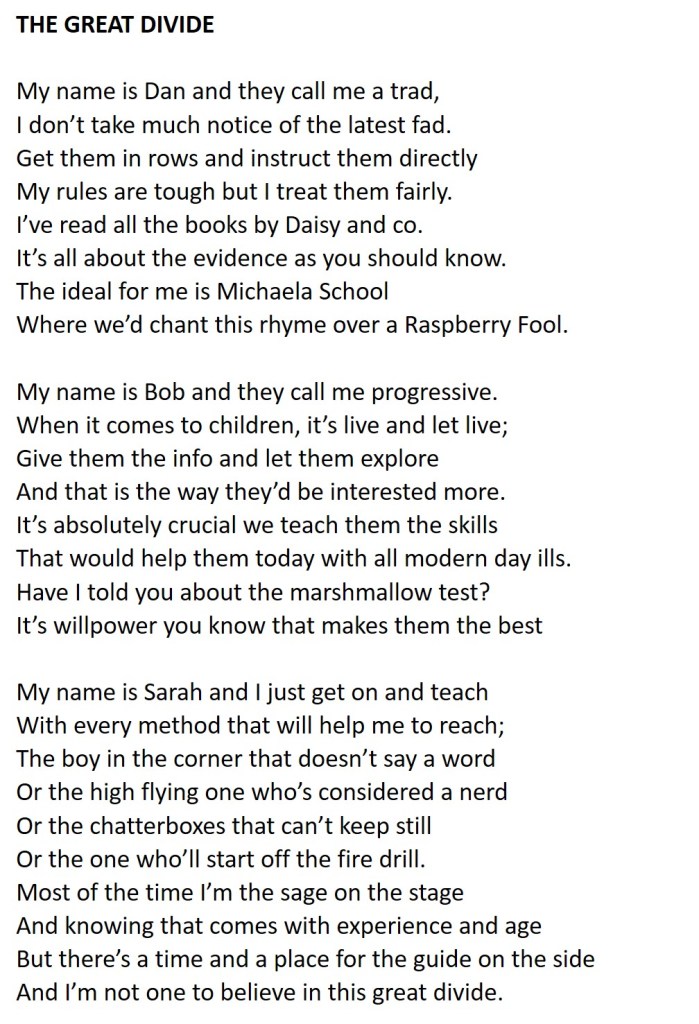
In teaching, we seem to be in a situation where there are just two solutions offered up to the problems in education. One is considered the traditional approach to teaching and the other is the progressive approach. You may have own your ideas what these mean but if not, I’m sure you can discover it quite easily online or on Twitter. In the educational world, the battle lines are drawn and soon the fighting starts between what method to use is.
But what Elinor said of the problems in economics is also the case in education. A one-size fits all approach, whether it is traditional or progressive, is not always the best approach, given what is going on at ground level. This could be the case not just for schools but also for classrooms as well. Most teachers appreciate this and will use different methods according to what they think is best for their students at that particular moment in time. On Twitter some educationalists will criticise others for what they are doing and yet they have no idea of the context of the situation. They think their way is the right way because it works for them in their school but sometimes, it might not and who should be the judge of that in other schools? Those that work there!
Dylan Wiliam’s quote about ‘everything works somewhere…’ is often seen as a get out clause for some people but in relation to Elinor’s work, it’s one of the most important bits of information a new teacher should be given. I think they should be encouraged to experiment with different techniques to find out what works best for them, in particular settings. We know that some things will work p.1 on a Monday morning but won’t work p.5 on Friday with the same class but we need to trust teachers on the ground to work that out, develop their teaching toolkit and get them to appreciate that it doesn’t have to be one way or the highway! We need to appreciate complexity in the teaching world and tackle it accordingly.
I hope you liked the poem.


 On Teaching...
You will be on strictly next. Liked the poem and the article.
LikeLike