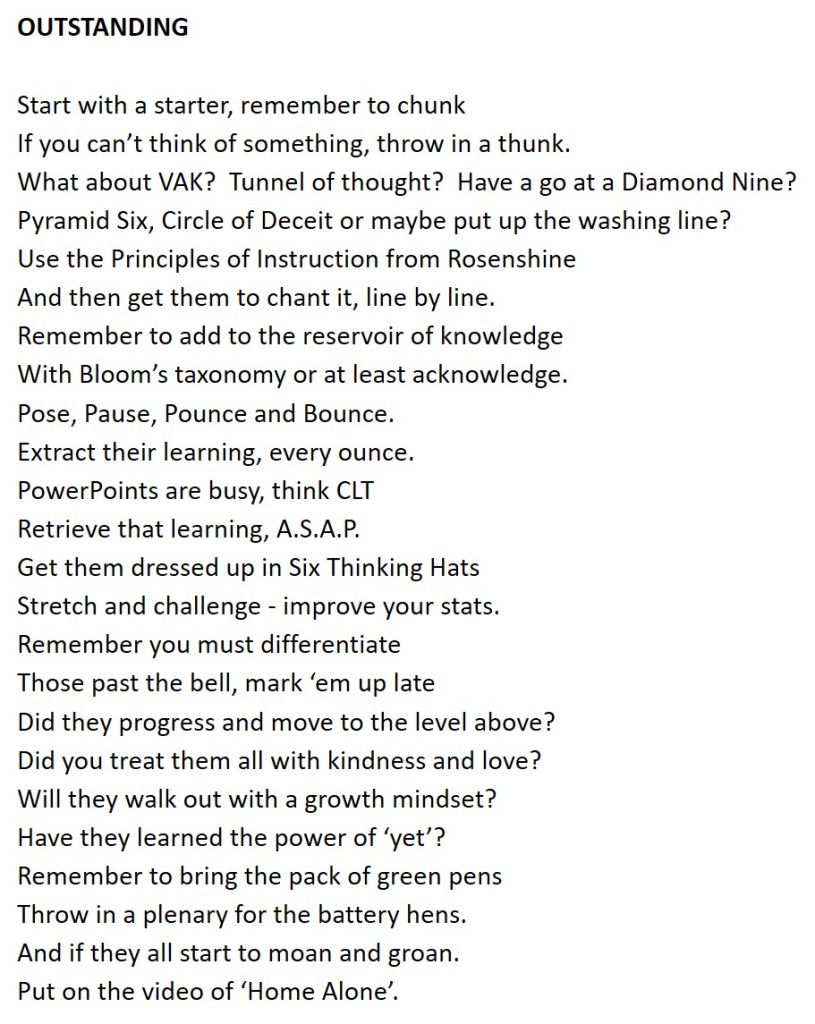
I think teachers are quite a cynical bunch. Whenever there is a discussion about a new teaching approach, there are many quizzical looks, some discussion and then most carry on regardless. This is why I’m always surprised to hear that our whole profession was supposedly taken over at some point by ‘edutainment’ and that we were all progressives being guides from the side.
In many respects I blame Daisy Christodolou’s book ‘7 Myths…’ and I’ve never understood why it has been heralded as an absolute game changer for the profession. In the book she uses Ofsted reports and Ofsted observed lessons as a way of understanding what is considered to be good teaching. I understand the reasoning because what Ofsted wants, schools try to deliver in order to get a good rating for their school. Unfortunately though, if you’ve only been in teaching for a short space of time, you would have missed how most teachers ‘gamed the system’ in order to get a positive lesson review and then went back to their ‘normal’ teaching, which clearly they thought was better than what Ofsted was looking for.
For example, in the build up to an Ofsted inspection, there would be much chat in a staffroom about what Ofsted was looking for at that particular time. Most staff (who want their school to get a good rating) toe the line and jazz up their lesson by bunging in whatever the latest craze was. After that moment, they would go back to what they would normally do, which is delivering knowledge from the front, with a few activities chucked in to see whether students understood or not. Most teachers would also do this if SLT came to watch because (again) it might be expected of them to follow Ofsted guidelines and most teachers want a ‘good’ lesson observation. Therefore, out of the 700 lessons or so each year that I might teach, 4 or 5 lessons might get observed where I change my teaching to suit Ofsted criteria – that’s 0.7% of my lessons. If you think reading observations of my lessons gives you an indication of the way I teach, then you would be very much mistaken and yet, for me (and obviously you can disagree with me) that’s exactly what Daisy does in her book. Ofsted inspections/reports are not a good proxy for how most classroom teachers teach and therefore she has spread a myth about how all schools were using ‘edutainment’ or ‘student centred learning’ to teach. The fact that teachers did change their methods for those lessons can be criticised and is a bit crazy but because it was such a miniscule part of their teaching life, it wasn’t a big deal. As soon as Ofsted left or SLT stopped observing, most got on and taught their lessons as they always did – delivering knowledge from the front. And you had to do that because it was the most efficient way of getting through the specification/curriculum in the time that was available to you. This means you couldn’t ‘edutain’ the whole time even if you wanted to!
Having said all that, if you look closely at a lot of teaching methods that are now heavily criticised, I’d argue that the majority of them are not as bad as everyone makes them out to be. As I’ve said, teachers are cynical folk so what would normally happen is that they might try something once (because they’ve been told to and they want to tick the box) and then carry on but that very nature of trying something, can get you thinking about your teaching. Take the much derided washing line. We were all given one at school and it must have taken an AST ages to put them together but I know that I used mine for a sorting activity related to business ratios for Tesco and Sainsburys. The time it took for the students to get up and hang up their ratios ultimately wasn’t really worth it but (and this is the key bit) it did make me think about sorting activities more generally to improve my students’ evaluation skills. The same for VAK – yes…I’ve done a questionnaire and had to think about visual, auditory and kinaesthetic approaches to learning but although there is no science backing it up, I’m not as aggrieved at VAK as most people are these days because it started a conversation in my school about teaching more generally. By investigating the so called different approaches, you actually came across methods (maybe accidentally) that did have some sort of scientific evidence behind it, such as dual coding and the use of mind mapping. Diamond Nine and Pyramid Sixes were all about trying to get students to think about justifying their responses. Growth Mindset is all about trying to get students to appreciate that with hard work and deliberate practice, they can get better at a subject. It’s not just sloganism and posters on walls, most teachers who advocate a ‘growth mindset’ will show students how they can improve…they don’t leave them hanging as many critics of growth mindset suggest and just say ‘put more effort in’, although for some students that would help!
Most teachers are cynical and question everything but also most teachers I know, do want to get better and be the best teacher that they can be. Therefore when new methods do come along, they look at it with a quizzical eye, give it a go and if it doesn’t work, they dump it and if they think it has some merit, they’ll use it. But at the heart of all teaching is the knowledge that the students have to know in order to past their exams. That in itself is quite a cynical approach to teaching but ultimately it is realistic and that’s why it’s a nonsense to suggest that delivering knowledge somehow went missing during the supposedly ‘progressive’ years.
And what happened to my washing line? Well funnily enough, I was lucky enough to go on a school trip to Tanzania where I actually used my washing line as a washing line! It worked a treat.
 On Teaching...