Featured

STRESSED, NOT STRESSED

For months I’ve had a pain in my stomach. It comes and goes but generally it stays…just there, like an unwanted visitor, disrupting my life, like the Tiger That Came To Tea or more like the Gerbil That Came For A Snack. Every now and then it will get so bad in class, that I will have to sit down and take a tactical time out. This is clearly not good, as it disrupts my normal way of teaching. Suffice to say I’ve been trying to get to the bottom of why this is happening and what I can do about it.

Over the past seven months or so, I have visited my doctor, had numerous tests and yet nothing conclusive has emerged. But guess what? It suddenly disappeared…the gerbil has gone. I’m no longer in discomfort. What’s going on?

Ever since I started teaching, I have always been quite chilled about teaching. One teacher in my first school told me I was the most laid-back teacher there. I’m still not sure whether that was a compliment but it might have been true. Ofsted never bothered me, observations, performance management, results meetings, delivering assemblies and so on. There would be a few nerves but nothing that would suggest I was hugely anxious or stressed. 

Fast forward 25 years and nothing noticeably has changed and yet, there I was with a pain in my stomach. And like I say…just like that, it suddenly went. 

Can you guess the day it went away? I’ll tell you in a moment but suffice to say, the years of being in the classroom have clearly taken its toll and the stress of being in the classroom has been making me ill, despite ‘not being stressed’. I know…it doesn’t make sense but stress is a funny old thing and it seems like I’ve been internalising it for years.

I’ve had a few clues along the way. One day on my normal run, I was bitten by an insect. I have no idea what it was but unlike any other time, I started to see bumps rising on my body, my breathing was going a bit funny and by the time I got home I was having a serious allergic reaction to whatever it was. For the next few hours I was in A&E being observed. I was then informed I had a very high white blood cell count and that it was likely to be caused by stress. I was quite surprised. I was then asked if I was a teacher. 

Sleep on a Sunday night should also have been a clue that something wasn’t right. During term time, nearly every Sunday sees me struggling to sleep, with my brain not really settling, despite having the same bedtime routines I have every other day. No phone in sight, lavender spray on the pillow and a chapter or so of a book. 

When I was trying to get to the bottom of my stomach pains, my doctor told me that he worked with 13 independent schools and he was often dealing with teachers that were stressed, who’d then go home and drink. This double whammy of stress and alcohol was creating these issues. I thought it couldn’t be stress and therefore it must be the booze, so I gave up the booze. I wasn’t a heavy drinker but did like a whisky or two on a school night. Now it’s 8 units a week, as suggested by the doctor. I actually thought drinking was helping because over Christmas, I had no stomach pains but maybe (I thought) it was suppressing the pain because after Christmas it came back even worse. It just so happened that it coincided with the start of a new term.

After weeks of little drinking, the pain continued but the doctor told me that all my results from the tests he requested were positive, there didn’t seem to be anything wrong. The final throw of the dice was a stomach scan and after that, all avenues would have been explored. Four months later I’m still waiting for the scan but maybe I don’t need it. The pain has gone.

The doctor had suggested three things – eat healthily (I do most of the time), exercise (I run each weekend) and try some mindfulness. Only the last one I do not do consistently but I have used breathing techniques but as I said, none of this has rid me of the pain in my stomach.

So what day was it that the pain went away? The day after my Year 11 and Year 13 classes had gone on study leave. This is both good and bad. Good that the pain has gone and I am more comfortable in my classroom but bad because I’m thinking, what’s going to happen in September? When I’m back to a full timetable, will my stomach pains come back? Everything I tried to reduce the pain didn’t help, only the classes leaving did and obviously that’s not happening in September. 

Therefore what can I do? Are there stress techniques I could use to help? Can I keep going through these teaching cycles managing the pain? Is this another reason why so many leave the profession, the sheer wear and tear of being a teacher over a certain period of time. I’m lucky I’m in a very good school, with lovely students, lovely staff and lovely management but I can imagine a more intense cycle of this, which burns teachers out very quickly. Who wants to be ill every day?

If you’ve ever felt like this, I’d love to hear from you and who knows, maybe you might have some solutions. Having said that, I might have a stomach scan and there could be something wrong after all. I’m not sure whether that’s better or worse!!!

Featured

THE JOY OF SCHOOL – #LOVEWHEREYOUTEACH

When you’ve been teaching for over 25 years, it’s very easy to lose your mojo when it comes to school life. I think it can happen anytime in your career but I was definitely struggling just before Covid struck and since then, there hasn’t been any sort of rebound. It’s never about the classroom though. I love teaching but it’s just everything else and post-Covid, it has only got worse due to the amount of additional work that schools have been asked to do.

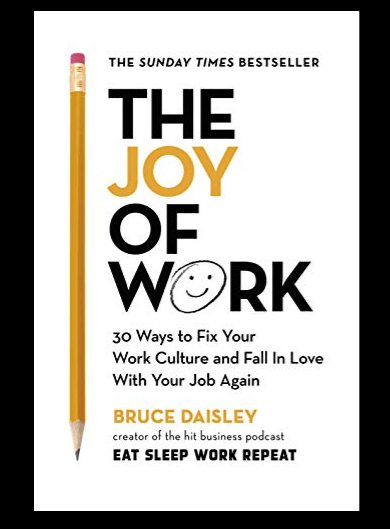
I’m still trying to find a way out of my current mood and in that respect, I recently read ‘The Joy of Work’ by Bruce Daisley, who has a hit business podcast called ‘Eat Sleep Work Repeat’ and is the ex-Vice President of Twitter. I found it very interesting and started making notes that I thought might be useful for applying some of the research and knowledge in that book to schools. So here goes, I hope it might be of interest. Obviously my reflections relate to the school that I teach in, which is by the way, a great school to work in but I’m a Kaizen man…always looking for continuous improvement!

  1. Staff Lunch Club – one of the big things I’ve noticed over the time I’ve been a teacher has been the death of the staff room. This has been due to workload issues but also the way new buildings have individual staff rooms for departments. This means you don’t bump into anyone anymore and you lose connection with your colleagues. Silos form and before you know, the bonding that you need for schools to work has disappeared. It has also been the case at my school that eating in the dining room along with the students has disappeared. The staff table has very few people in it where previously it used to be a hotbed of conversation across departments where you got to learn about little tricks that you could use with different students or at least appreciate that we were all in the same boat when it comes to the more interesting characters in lessons. So what can you do to bring about these really important informal discussions? Well…is it possible to offer a free sit down meal once a week to staff? Can you arrange a staff lunch club once a week? Or encourage trips to the staff room by offering free tea and biscuits one day of the week? It might be costly but if it leads to more well connected, happier staff, then it pays for itself.
  2. Walking Meetings – one of the changes I made to make myself happier was giving up being Head of Faculty, mainly to avoid Heads of Department meetings. It sounds a bit odd to give up pay for that but I just hated those meetings with a passion. In ‘Joy of Work’, there is a lot of talk about meetings and how to get the best out of them. Most of the time at the HODs meeting, you are discussing an issue and then feeding back. The problem is that there are often too many people and certain voices dominate. To improve this, I think the idea of walking meetings is a good idea that’s worth trying. Randomly pairing up HODs and telling them to walk around school for 7 minutes discussing it. Apparently it’s very good for creativity and problem solving. They can then feed back after that time. Also, being creative and solving problems is much harder to do after working long hours and being stressed. Why are so many meetings that are hoping to solve problems held straight after school? Can you switch to morning meetings (if you need a meeting at all…this is another thing the book discusses) or at least build in an obvious break before beginning the meeting? Most of the time staff are rushing straight from their classrooms. School days are stressful…SLT should really expect no good ideas to be suggested in after school meetings.
  3. Buddy Systems – The social side of school, as already mentioned, is vital for staff wellbeing. One way of connecting people is to have a buddy system for new members of staff. I’m sure this happens at many schools but does it happen across departments? I think it would be really good that a new member of staff should have a buddy from the other side of the school, so a new Maths teacher would have a History buddy or a new Science teacher would have an Art buddy. Not only will they see a different side of school life but they will both collect different information from other areas of school to pass back to their own department. Another idea that could be taken from the book is getting members of staff (pick 3 at random) to just talk about themselves at a staff meeting – how long have they been teaching? Why did they get into teaching? What have they been most proud of as a teacher? What are their hobbies outside of school? What’s their favourite joke? It might be a bit embarrassing at first but if it is done regularly it becomes the norm and staff will connect more.
  4. Invite a Random – When you work in a team, it’s very easy to get into groupthink mode after a while. I think a really interesting way for SLT to avoid this is to invite a different member of staff to SLT meetings each week so that you can get an alternative viewpoint on things. It can be quite easy to forget what it’s like to teach a full timetable and have a form. It will also enlighten the member of the staff to see how decisions are made at a senior level and how tough it can be. It’s a win-win on both sides. It’s very important though that the chosen member of staff feels free to speak openly and is asked to comment without judgement. The book suggests some ways of doing that, such as using a visual to depersonalise the conversation.
  5. Hack Week – Giving staff time to do their own thing is really important when it comes to motivation. We have done this on training days before and we call them Fed-Ex days. This is good in terms of what Daniel Pink talks about in Drive – autonomy, mastery and purpose. Teachers have been allowed to choose their own focus for a CPD day and can visit anyone they wish or do anything, as long as it links to improving themselves as a teacher. No marking allowed! But a ‘Hack Week’ seems quite different and you can imagine it working quite well in school where for a week, you drop all regular meetings and you just focus on one area of school life and at the end of the week, you all get together and celebrate the ideas that that could really improve the school – themes could be behaviour, school site, communication, social side, T&L…anything really but there has to be an openness to discussion and framed in a way that it’s a problem that everyone is trying to solve.

What do you think? Are these good ideas or not? Are they workable? Does your school already do some of these things? If these were introduced, would you find yourself writing tweets that included the hashtag #LoveWhereYouTeach? Hopefully most of them make sense without reading the book but if not, read the book! The key takeaway for me is that schools should be trying to create an environment where staff bump into each other more on a regular basis to create a ‘positive affect’ and that all members of staff know that they can speak up on issues and feel ‘psychologically safe’ in order to create that ‘buzz’ (as Bruce Daisley defines it) within their school. 

Featured

HOW TO GET ‘INTEREST’ IN YOUR SUBJECT TO BOOST LEARNING

In Michael Lewis’ latest book ‘The Premonition: A Pandemic Story’, one of the chief protagonists, Carter Mecher, points out that people don’t learn what is imposed upon them but rather what they freely seek, out of desire or need. For people to learn, they need to want to learn. He uses a really interesting example about travelling by air and pre-flight safety instructions. He explains how airlines try to hammer these safety instructions into the minds of passengers and yet, despite hearing them several times, you would struggle answering questions, such as ‘How many exits are on a 757? Four? Six? Or Eight?’ and ‘What does orange and red lighting identify?’ and so on.

When I read this, it made me consider spaced and retrieval learning. Although this is not a perfect example, frequent flyers would, in essence, be learning how to be safe on a plane using the science of learning techniques that are often discussed in the classroom and yet, as Mecher points out, the knowledge won’t stick because they have no desire to learn it. 

Because there has been such a focus on retrieval learning over the past number of years, many teachers, myself included, will use a retrieval learning activity as a starter to the lesson. Often I will use the Retrieval Roulette template created by Adam Boxer to get them in the right mindset for learning but I’m now concerned that it won’t work as well as I would have hoped because they simply do not want to learn what I’m teaching, no matter how often I repeat it. 

So I got curious about curiosity and delved into the research to see how you can encourage curiosity in your classroom, so that students really want to learn your subject. Here are some of the ideas that might just help.

  1. THE HOOK AS A STARTER – Researchers from the University of California conducted a series of experiments to discover what happens to our brains when our curiosity is aroused. They asked participants how keen they were to learn the answers to certain trivia questions, such as ‘What Beatles song lasted longest on the charts?’ and whilst doing that, they carried out random fMRI scans to see what was going on in the brain. One key takeaway was that once someone had been made really curious, they ended up being better learners and retaining more information, even when it wasn’t related to the original question. So instead of having a retrieval learning quiz at the beginning of a lesson, why not have an unusual picture on the board? Or a song playing with a link to a topic? Or a big question related to your topic area that’s quite controversial? Or how about Nob Yoshigahara’s infamous number puzzle? Look it up…it’s a cracker.
  2. QUESTION CORNER – It’s questions that stimulate curiosity, so why not set up a postbox in your room  or online and encourage students to post any question they want on your subject. Explain that there is no such thing as a bad question and they can let their minds wander. Then once a fortnight, take a few questions from the postbox and get a conversation going.
  3. SHARE YOUR CURIOSITY – As teachers, we always have to remember that we are role models and therefore we have to continually show that we are still curious about our subject. I mean, if we’re not interested, why should they? In Economics, there is always a new piece of data that appears on Twitter and I love putting it up on the board and trying to explain what it makes me think. Then I will ask them and see if they’ve got any thoughts. It’s even better if it connects to some prior knowledge because, according to the research by Paul Silva, new and complex things are interesting if people feel they are able to comprehend them and master the challenges they pose. What that basically means is that prior knowledge is essential and you as a teacher can provide a bridge that connects old knowledge to new through a curious question or a new piece of data.
  4. VALUE INTERVENTION – As an early homework or class activity, ask students to write down why they think the topic they are studying can help them later on in life. This links to a study by Judith Harackiewicz and her colleagues at the University of Wisconsin that asked students at college to think about how maths would play a role in their lives. After doing this, the students became more interested in the subject, much more so than when the teacher told them how valuable the topic was. In fact, this put off many students, who did not consider themselves good in the subject. Therefore it’s essential that students work out for themselves why learning is good and why it should be valued. Harackiewicz calls this ‘value intervention’ but teachers can help and so can parents by simply asking questions such as ‘Why do you think that might be useful knowledge to know if you were a…?’ or ‘Where could you use that information?’
  5. MOTIVATION CONTAGION – A study conducted by Burgess, Riddell, Fancourt & Murayama, suggested that motivation can be contagious. When students observe another student being curious about a subject, they are likely to become curious as well. Therefore it might be worthwhile, when considering a seating plan or how you organise your classroom, to put the most curious, motivated students next to those who struggle somewhat. You will have to facilitate collaboration but if you have that big hook at the beginning of the lesson and then use ‘Think, Pair, Share’, then you should see positive results.

If we can get our students to be as curious as Carter Mecher, then we would have done an exceptional job. Thanks to Carter’s curiosity, he ended up exploring the Spanish Flu of 1918 and from that ended up writing a Pandemic Plan that explained the importance of social distancing, wearing masks and targeting super spreaders. It could have saved thousands of lives. I say could but it didn’t…are you curious to find out why?

Featured

WANT TO KNOW THE SECRET OF NATURAL TALENT? SHHHH…MUM’S THE WORD!

I’ve recently been reading Edith Kuiper’s book called ‘A Herstory of Economics’ and it has got me thinking…a lot. In particular I’ve been thinking about talent and where it comes from. Most of the time, when we think about talent, we describe it as being something quite natural. They are a natural at Economics or they are a natural sprinter or they are a natural artist! It’s God’s gift and has little to do with anything else. 

Many moons ago when Carol Dweck first developed the concept of Growth Mindset, a colleague and I tried to explode the prodigy myth in school and explain to students that there wasn’t such a thing as a natural talent. In fact, around that time, I stopped saying ‘She/He is a natural in Economics’ at Parents’ Evening and inserted a line in a little handout that I give out on the night (called ‘How You Can Help in Economics’) that states ‘There is no such thing as a natural economist’. How did we get to that stage? Well…a lot of it came from the 10,000 hours research that was cited in a Malcolm Gladwell book. The research suggested that to get to be a top performer, you had to have done at least 10,000 hours in your chosen performance area. Since that book came out, there has been much debate around that number but at the time it was interesting to dig into the lives of people like Beyoncé and Judd Trump and find out why they had become so successful.

What we soon discovered is that for nearly all the people we looked at, they had a hugely supportive home environment from a very early age, where their parents would play with them, sing with them, take them to events all around the country, get them additional teaching, back them financially, let them take risks (and sometimes fail) and so on. We put all these posters up of famous people around the school and visited all the Forms to show that it was hard work that made them successful and not much else. I’ve still got the PowerPoint if anybody wants it. We even made badges that said stuff like ‘Effort Is Everything’! They didn’t have a unique talent, they just put the yards in. And in many respects, this is reflected in a lot of the science of learning today. Retrieval learning links to continual practice…you just have to revisit your learning again and again and again and again. Neurons that fire together, wire together!

What has this got to do with Edith Kuiper’s book about women in economics? 

When you read her book, one of the things you find out straight away is that historically, the men who were writing about Economics had absolutely no interest in what was going on in the home. Take for example Adam Smith, who is considered to be the ‘Father of modern economics’ and his major work ‘The Wealth of Nation’. There are very few references to women in his book and the contribution they make to society. This has had a long term impact on modern economics because the way we measure economic growth (GDP) does not include work done within the household. Women economic writers on the other hand understood the value of all this and wrote about this as well as the crucial role education played in giving the skills required to lead a good and responsible life. 

Alas, women were not allowed a voice in Economics and therefore much of this writing was ignored and the men just focused on the ‘productive’ work that was being done outside the household. As Edith Kuiper writes ‘As raising and educating (younger) children was assigned to women, the relevance of education, particularly of younger children, has not been fully recognised by economics. Differences in children’s potential therefore became understood not as resulting from differences in attention, love, and resources accessible during the first years of a child’s life, but as inherited talents…’.

Think about that for a moment. It’s quite revelatory isn’t it? We automatically assume children have a natural talent in something because we don’t really value the role women (traditionally) have played within the household creating an environment to maximise learning. In fact it’s easier for society to claim that something is ‘natural’ because then you don’t have to consider government policies that might give EVERY household the opportunity to create that environment for great learning.

Think about that when you next call someone a natural talent. Now you know the secret…mum’s the word!

Featured

IN DEFENCE OF EDUMYTHS

Over the past decade or so, we have seen a number of takedowns of particular ‘edumyths’ thanks to a rise in awareness of the evidence in education and how learning happens. As teachers, we can all reel off our favourite ‘edumyths’ – VAK and learning styles, ‘brain gym’, the learning pyramid, the right and left brain, to name but a few. On Twitter, there will be much guffawing that this occurred and some will post lesson plans that highlight how a certain ‘edumyth’ was expected to be evidenced in lessons.

I’m not going to go against the science of the ‘edumyths’ as clearly there is evidence that shows they are what they are, myths but what I want to do is explore how they were less damaging than many suggest and in fact, in many respects were quite positive given the state of education at the time.

Before I go on, I’d like to quote George Orwell’s ‘Homage to Catalonia’ and the final passage in his book, which relates to his viewpoint on the Spanish Civil War.  

“And I hope the account I have given is not too misleading.  I believe that on such an issue as this no one is or can be completely truthful.  It is difficult to be certain about anything except what you have seen with your own eyes, and consciously or unconsciously everyone writes as a partisan.  In case I have not said this somewhere earlier in the book I will say it now: beware of my partisanship, my mistakes of fact, and the distortion inevitably caused by my having seen only one corner of events.  And beware of exactly the same things when you read any other book on this period of the Spanish war.”

Clearly I am not writing about the life or death situation of a war but in the heated debates among educators, it can get pretty serious out there and therefore we must remember this fundamental point – your truth is not my truth, within a school/classroom environment and therefore whatever I write now, you may not recognise at all. So here are four reasons why ‘edumyths’ were good for education.

  1. Getting the conversation started – before VAK and the introduction of learning styles questionnaires in the classroom, there was not much professional dialogue surrounding what we did in the classroom. In many respects, VAK forced us to stop and think and question whether this was really true. From this, you’d suddenly see teachers discuss pedagogy. It might be a derogative ‘what do you think of this VAK nonsense?’ fashion but all the same, it got people talking and from that perspective it was a huge moment.
  2. Mixing things up in the classroom – in order to implement VAK within the classroom, you had to come up with resources that addressed your (supposedly) different visual, auditory and kinaesthetic learners. Many would argue that creating ‘sorting cards’ or doing a ‘Thunk’ was a waste of time but I would argue differently. If we are to stop boredom within the classroom, it is vital that every now and then, we mix up the delivery of our content. According to a recent study*, boredom leads to sadism within the classroom and therefore many teachers who went through the VAK years or created ‘brain gyms’, are likely to have a range of resources and activities that they can dip into, just to shake up the classroom a bit and stop bad behaviour in its tracks.
  3. A gateway to the ‘real science’ – in many of the ‘edumyths’, there are links to what are now considered to be the six most effective learning strategies. For example, the learning pyramid explained how much we remember given the method that we use. For example, 10% of what we read, 20% of what we hear and so on, all the way up to the amazing figure of 90% for what we teach. As we know, this has been debunked but this myth would have encouraged teachers to get students to explain concepts to each other. Through this, they would probably end stumbling upon ‘elaboration’ or coming up with their own ‘concrete examples’ that are part of the six effective learning strategies. Mind mapping, that was encouraged for kinesthetic and visual learners, would have been ‘dual coding’ before ‘dual coding’ became a thing.
  4. Questioning the next big thing – as ‘edumyths’ were slowly exposed, it made teachers more questioning about the research that was coming their way. As The Who once sang ‘we won’t get fooled again’ and therefore the teaching community has become much more evidence focused and more informed about what makes good research. How big was the sample size? Has it been replicated? Has it been tried in numerous settings? Who has funded the research? These kinds of questions are crucial in making evidence informed education better in the future and ‘edumyths’ was the starting point for this.
  5. Metacognition for beginners – before VAK, we never really asked students to think about their own learning. This is now a huge area in schools and although misguided, the VAK questionnaires would have been one of the first times students stopped and thought about how they learn. The seed had been sown. 

As you can see, for me, the ‘edumyths’ acted as a catalyst to the thriving educational environment that we are living in today, where we are evidence focused, happy to discuss pedagogy and ask students to consider their own learning. These important activities were simply not happening when I first started teaching and education is in a much better place because of it and for that, we can give thanks to the ‘edumyths’.

*file:///home/chronos/u-672c8f825b61597ef72ebfd1f3b04b6ff9f88902/MyFiles/Downloads/Boredom%20and%20Sadism%20at%20Schools_v2.pdf 

Featured

Human Development Index for Pupils – Reach for the STARS!

There is a continual discussion in education about the purpose of exams and how it will often under-value or over-value students in terms of their value to the world. For example, we probably know many students who are very good at passing exams but are incredibly rude and have very little empathy. On the other hand, we will also know lovely students, who help others, are very respectful but unfortunately struggle with exams. Unfortunately for the latter students, their exam grades are what defines them in our current model of society and they are seen as failures; whilst the former students end up running the country, over-seeing thousands of avoidable deaths and somehow, that doesn’t seem right.

Recently the Economic Observatory produced an article called ‘How should we measure the development of human capital in children?’ which is a brilliant read. It really gets you thinking about the measurements we use and the variables that influence that, as well as some of the characteristics that are seen as good but we find hard to measure in a school context.

As an economics teacher, this made me think about the recent podcasts I have recorded with my friend about the economists Simon Kuznets and Amartya Sen. In both these episodes, we discuss how GDP (Gross Domestic Product) became the most important measure for an economy and how in recent times, the tide has started to turn against it. The criticisms of GDP are many but as Bobby Kennedy once said about GDP of America ‘…it measures neither our wit nor our courage, neither our wisdom nor our learning, neither our compassion nor our devotion to our country, it measures everything in short, except that which makes life worthwhile.’ and in many respects, this is how I feel about the way we measure students in school at the moment through the exam system. 

In the Sen episode we discuss how his work shifted the thinking about GDP and his work inspired Mahbub ul Haq who created the Human Development Index or HDI. This still recognised that GDP was an important component of a country’s standard of living but it wasn’t the full story. He suggested that life expectancy (a health indicator) and average years of schooling (an education indicator) should also be recognised and thus, HDI was born with each factor given an equal weighting.

It is therefore easy to make a leap from that into the school system. Obviously examinations are an important component of a student’s value but it is not the only one. Therefore we might want to consider how we could create a similar type of index for students, as we have done for economies across the world. Let’s start by giving it a cheesy name – The STARS index. This would stand for something like Standardised Tests And Relevant Skills index.

What would be included? Alongside examination grades, it would make sense that we should add in a physical health component. Many studies have shown that physical exercise is good for both body and soul and a student’s value to society would be enhanced if  they were physically fit. A teamwork component would make sense alongside an empathy element, that reflected their value as a decent human being. There would be disagreements as to what should be included, as there is with HDI but a more holistic viewpoint of a student would certainly be more advantageous than our current exam obsession. The DfE could decide what the components would be, create a weighting for each component and voila! The STARS index is born. Instead of students needing a certain grade criteria to get into a particular institution, they would need a STARS number instead. Those students who wanted to go to Oxbridge would not only need good grades but be a more well rounded student.

Now many of you at this point will be shouting (apart from exams) HOW DO WE MEASURE EACH COMPONENT? But thanks to Covid, we have now reached a situation, amongst a large part of society, that believes teachers can be trusted when it comes to assessing students. I personally would be in favour of each teacher giving students a rating for the empathy components – using the wisdom of crowds – in order to create an average score so that no individual teacher could be pressured into increasing a score. It could be scored 3 times a year based on their general behaviour around school and in lessons rather than ‘empathy exams’ or ‘teamworking tests’. Not only would this give a fairer score, if they knew about this index at the beginning of the school year, you would expect to see better behaviour across the school.

So what do you think?  Would the Department for Education go for it? Should I start getting S Club 7 ready to do the launch campaign? It would be interesting to know what you think.

Featured

HOW SUBTRACTING CAN ADD TO YOUR SCHOOL PERFORMANCE.

In a recent book called ‘Subtract – The Untapped Science of Less’, Leidy Klotz, a professor at the University of Virginia has looked at the ways that we often neglect thinking about subtracting as a way of solving problems. Normally when an issue arises, we often feel the need to add something, so in the economy, we will add new roads to deal with traffic issues or we will add new home furnishings to beautify a house but we will never think about taking something away. The main reason behind this, as explained in the book, is that we have been set up from an evolutionary perspective to add (or hoard) to survive and this continues today.

It’s an interesting book as it shifts your way of thinking and I would encourage teachers and leaders to read it. The thought process can certainly be applied within a school setting to revolutionise the way we deal with problems, as well as improving learning for students. 

Four ways schools can subtract:

Behaviour outside the lesson – one of my friends worked at a school where they were continually dealing with issues related to ties. Detentions were being given out continually but it didn’t seem to make much difference and just created a negative atmosphere between staff and students. Normally a school would add more rules to deal with the issue but what they did is subtracted the tie. Ties do not impact learning but the time wasted dealing with them did and so they swapped to polo shirts without ties. Whether you agree with the school or not, it is a great example of subtracting to solve a problem and it improved relationships within the school.

Behaviour inside the lesson – there are many rules/expectations within a school setting and they can be overwhelming to think about for staff and students. They will be up on a wall somewhere, normally in small font, barely getting noticed. In the book, Klotz talks about his sister, who is an Emergency Room doctor, distilling her decision making process with regards dealing with patients into three key points, in order to save lives. Of course there are more things she could think about but these are three that are essential for her. Clearly this is something we can do within our classrooms. In fact, in the excellent FutureLearn course ‘Managing Behaviour for Learning’ with Paul Dix, this is something that is advocated. Get your fundamentals on the wall in your classroom, show them to your students and consistently refer to them so they have no excuses. I have five key behavioural points on my wall but one assumes this can be done (and probably is) on a whole school basis to provide consistency in the classroom.

Impactful lessons – cognitive load theory has been discussed much in education over recent times and Klotz uses this as a reason for why subtracting is vital. Something I have tried to do more in my teaching is to say ‘when you leave this classroom, the three main points I want you to remember are…’ in order for students not to be overloaded with the content I have delivered in class. When reviewing a lesson, it’s always very easy to say ‘I should have done more of this’ or ‘we could have added another exercise’ but not what we could have cut. Looking back at past PowerPoints, I can see the way I have added additional slides throughout the years, as a security blanket, to make sure I’m covering content but I can now appreciate how this can create cognitive overload. Now I’m looking to teach better by subtracting, whilst working on alternative ways of giving students my security blanket. I’ve written a bit more about stripping back a lesson to the essence in this piece about bass playing.

Better student responses – there is a great quote used in the book that is attributed to Mark Twain which states ‘I didn’t have time to write you short letter, so I wrote you a long one.’ Klotz uses this quote to highlight the effort you need to put in, in order to subtract, whilst also highlighting the skills of an excellent editor (if it’s not obvious by reading my blogs!). Students will often write overly long answers in tests because it’s easier to keep on adding rather than putting the effort in to finely tune their writing to the question being asked. This is an area where we can really help students by taking answers and editing responses live in front of the class using a visualiser. In a recent exam that I marked, a student ran out of time and I tried to highlight the numerous examples where they had written too much, despite warnings not to. The best students are the best at subtracting and we need to train them to do this better.

‘Subtract’ is an interesting book to read and Klotz highlights that you can both add and subtract when it comes to problem solving, it’s not an either/or discussion. At this moment in time though, most people will only look at ‘add’ solutions and will not consider subtracting and this is something he wants to change as it opens up a whole new world of possibilities. 

Featured

IT’S ALL ABOUT THE BASS.

Over the past year, I have found great solace in trying to improve my bass playing, mainly as a distraction from the stresses of education and as a way of stabilising my mental health. As the worst member of the greatest (cough) staff band around – The Lines – I have always tried to bring energy to the group but really, I should bring better bass playing. So recently I have been trying to learn a variety of bass tabs, with varying rhythms and from different genres, from the Spice Girls to AC/DC and beyond. Whilst on this learning journey though, it made me reflect on how bass playing offers many lessons to the classroom environment.

  1. The rhythm of the lesson – along with the drums, the bass player makes up the rhythm section of most bands. They keep a steady beat that drives a song along. Sometimes the pace will need picking up and sometimes it will need slowing down and this is exactly what a teacher is doing within the classroom environment. They are continually assessing when a lesson has started to drag and needs freshening up but at other times, particularly after question and answer sessions, it will be important to slow things down in order to ensure that everyone has understood the learning objective.
  2. Knowing what to leave in and what to leave out – when I’m learning the bass, I’m trying to replicate bass players who are much, much better than me and most of the time I can’t…yet! There are ghost notes, slides and pulls that I struggle to do, despite hours of practise but when push comes to shove, most of those fancier elements are not needed for the heart of the song. Therefore, I simplify the tab in a way that means I can play it and the band can perform. At the start of teaching, it is very easy to over-teach subject areas that can overly confuse students. You do this normally because you can feel confident that they know more than enough to answer any questions asked around the topic. However, this often puts additional cognitive load on students and they may struggle to remember the core concepts that are essential to do well or get confused about what the most important information is. So a good skill to have as a teacher is that appreciation of core knowledge and knowing what to leave in and what to leave out as you teach. You can always tell students about the hinterland and get them to explore it in their own time. A bit like when I try and stretch myself with a big bass slide during Lizzo’s ‘Juice’.
  3. Mix it up a bit – recently I have purchased a bass guitar pedal, the Big Muff Pi Distortion to be exact. I wanted to play ‘Figure It Out’ by Royal Blood which has a lot of sustain and distortion on it. When I turn the pedal on it sounds great and I feel proper rock and roll. However, at the heart of the song is a very simple catchy bass tab and that’s important to remember. In teaching, we often feel that we have to have lots of tricks up our sleeves to keep students interested in lessons but ultimately if you have good teaching at the core of your lessons, the students will be engaged no matter what. Of course it’s good to use the teaching equivalent of a bass pedal once in a while but don’t get distracted from the basic techniques needed to deliver a solid performance.
  4. Learning is the focus – name a famous bass player? It’s pretty difficult isn’t it? There are the odd ones who are well known purely for bass playing like Mani from the Stone Roses or Flea from Red Hot Chili Peppers but the main ones known are those that have fronted a band like Mark King from Level 42 or Lemmy from Motorhead. Generally, the bass player is the one person you can’t get in a pub quiz when trying to name the band! In many respects, the bass player doesn’t want to be noticed, like John Deacon from Queen. As previously stated, the bass player’s role is keeping the flow going whilst allowing others in the band to shine. In many respects, you could argue that teachers are like lead singers, keeping the audience spellbound in the classroom but really we should be more like bass players, allowing students to shine through their contributions to the learning environment. The learning is the focus and not you, despite what many might think! And this has nothing to do with the fact that I’ve never done a bass solo for The Lines…mainly because I can’t!

So there you have it…I’m sure most people can see how doing one thing, such as playing the bass, can give you insight into how to do your job better or at least remind you of some of the key elements that bring about great performance in the work that you do. Why don’t you give it a go? How does rock climbing make you a better teacher? Or collecting stamps? Or brewing your own beer? Have a think…and listen to the amazing bass player Bootsy Collins whilst you are doing it!

Featured

BEWARE THE ZOMBIE TEACHER!

After the financial crisis of 2008, a phenomenon emerged in the business world that has continued to this day – the ‘zombie’ business. This is a business that staggers along, earning enough money to cover its debt but not enough to pay it off. It covers daily expenses but doesn’t make enough to invest in itself to grow and make it better. Often they are reliant on loans from the bank to keep going. Sooner or later, they fall and die. Normally it will be a poor quarter or some unexpected event that pushes them over the edge. A good example recently has been Debenhams but sadly there have been lots of recent examples hence ‘the death of the high street’ and the lockdowns have only accelerated the process of ‘zombies’ finally falling.

There is obviously an equivalence here with teachers. We can see in the data that there are many potential ‘zombie teachers’ out there. We are all aware of polls that suggest two in three teachers want to leave the classroom within two years and there is no doubt that the mishandling of education over the past year would have pushed many more into thinking about their career in teaching. 

The constant criticism of teachers during lockdown when it was assumed we were all on holiday, the continual U-turns from government about a number of educational issues, the pressure from parents with regards the centre-assessed grades (CAGs) and the expectations about online teaching would have pushed teachers to the edge.

Clearly in the middle of a pandemic induced recession, this is not the time to quit teaching as you would find yourself in the middle of a hugely competitive labour market and like ‘zombie’ businesses, ‘zombie teachers’ have bills to pay and therefore they will continue in the classroom, feeling disgruntled, demotivated and disrespected. This can be seen in the data where there will always be a time lag with regards quitting the profession.

Obviously some of the responses in these surveys will be bravado or heat of the moment stuff but there seems to be something quite different about the way we are currently seen by this government and some of the more vocal members of the mainstream media. Long after Gavin Williamson has gone, there will be a need to heal the divide between the profession and Whitehall. This has not been helped by a Prime Minister who was prepared to put our lives in danger and a Chancellor that has already announce a pay freeze.

Therefore classrooms up and down the country might be swarming with ‘zombie teachers’. This might not be obvious to students, after all, we are a caring profession and on the whole will do our utmost to give them the best education possible but if you think you are going to leave the profession within a couple of years, then standards might start slipping in areas that you might not see as being worthwhile. There might be a lack of engagement at CPD events and an unwillingness to offer extra-curricular activities and other additions that come from the ‘goodness of the heart’.

This disillusionment will have to be carefully managed. It might be that after all the lockdowns are over and teaching becomes normal again, most of the past year or so might be forgotten but with pay freezes locked in and catch-up classes expected for another year or so, this is unlikely. 

This is obviously another issue for SLT to deal with, who themselves are likely to be suffering. There will no doubt be plenty of ‘zombie senior leaders’ as well and this can be seen in the data also with over two-fifths of teachers, school leaders and support staff wanting to quit within the next five years. This was originally due to ‘workload pressures’ and ‘excessive’ accountability. Now imagine that over the next year or so and what we have seen recently! Clearly for many, the coronavirus will be the unexpected event that will push many over the edge. Let’s hope there is a safety net.

Featured

UNDER PRESSURE – The legacy of CAGs.

‘Have a fun INSET day everyone. What are you doing?’

‘Revising’

‘Have a lovely weekend everyone. What are you all up to?’

‘Revising’

‘Anybody up to anything fun this evening?’

‘Revising’

Revising, revising, revising. That’s what Y13 students tell me all the time now. It didn’t use to be like this. They’d tell me about the party that’s on at the weekend or the shopping trip they were going on but now it is revising, revising, revising. Why is this? It’s not lockdown, the rule of six or the 10pm curfew. The answer, quite simply, is CAGs.

The summer debacle of no exams has left a legacy like no other. When it was decided that centre assessed grades were going to be used for students’ grades, the rules of the schooling game had changed. The destiny of a student’s grade was no longer in the lucky dip of a one-off set of exams but potentially in the continual assessment from their teacher. This means that every assessment at school now REALLY meant something. If CAGs were going to be used again (and the government hasn’t ruled it out), then they will have to perform better than their classmates in every test/assessment/assignment, in order to achieve a high ranking from their teacher.

It doesn’t matter if a teacher tells them not to worry about a test and patiently explains to them that a test is purely about finding out what they don’t know, if the teacher is collecting the data, then the students will be concerned and will be desperate to do well. Sixth Form students are not stupid and if CAGs are going to be used, the teacher will have to use every bit of data at their disposal in order to justify why they have given certain people a grade and why they have ranked them above someone else.

Of course, you can say you will only use a Mock result but what if a student gets the same score as someone else? Then other data will have to be used to separate as you can’t rank at the same level. What if someone has a ‘bad day’ in the mock? Surely it’s right to use other data isn’t it? Of course but then we go back to every assessment matters and if every assessment matters, you can understand why students are revising, revising, revising.

And what impact is this having on students’ wellbeing? If students are continually pushing and pushing and pushing, then eventually something is going to break. I’m sure I am not alone in believing that my students’ mental/physical health is more important than a letter on a piece of paper. But this is the situation we have ended up in and everytime I see an article about using teacher assessment and cancelling exams, I want to roll up and die.

Obviously I know that exams are not perfect but are people like Kenneth Baker aware of the impact that CAGs will have on schools and the students themselves? It’s not just about the constant workload the students will feel they have to do but it will lead to a breakdown in the relationships between students, teachers and parents. Imagine a mock exam where a student is two marks off a higher grade. Marking is subjective, we all know that, hence all the remarks in a normal summer, therefore the student will be desperate to find those extra two marks, just in case the mock gets used as the CAG. What happens if a teacher doesn’t give it to them?

We have already seen relationships break down after the 2020 CAGs, with many people contesting their results and causing huge misery for everyone involved, as well as wasting a huge amount of resources within the school setting. It’s understandable if you are unhappy to challenge the school…a parent wants what is best for their child but ultimately not everyone can get an A or A*.

I’ve been amazed that there have been so many people on Twitter who would be happy to continue with teacher assessment. I genuinely felt it was the worse thing I’ve ever had to do in my teaching career. It was like the educational equivalent of ‘Sophie’s Choice’. You have spent two years getting students ready, enjoying their company, revelling in the camaraderie of it all and then suddenly the onus is on you to rank them and give out grades that you genuinely aren’t sure about. I’ve written before about the difficulty of predicting grades and therefore the thought of them being used horrors me.

I was genuinely happy when I saw a TeacherTapp survey that suggested that teachers didn’t want exams cancelled but was still amazed that 28% wanted them to be. I just don’t get that given the additional pressure put on teachers and students for the whole year.

I would love the government to do the exact opposite of what Kenneth Baker suggested and announce that, by hook or by crook, the summer exams will be going ahead. If teachers are concerned about finishing courses, either make them later or cut some content as they have already done. What we can’t have is students continually on the edge…it’s a depressing time to be a teacher at the moment and it’s even more depressing knowing that these fun loving teenagers are forever stuck in a room revising, revising, revising.

Featured

WHAT ARE YOU REBELLING AGAINST? WHAT HAVE YOU GOT?

If you look around at the moment, the world seems an angry place. There has been a fair bit of writing on it and many commentators think it explains why Brexit occurred and why Donald Trump was elected in America. If you spend any time on Twitter or Facebook (in public forums), you will see that anger again and again and again. As a teacher, I’d like to think that in the world of education, this wouldn’t happen. We’re educated people and therefore you’d expect to see a bit more nuance in terms of the discussions that we have but every now and then, you’ll see anger and lots of it and it makes me think why? Why do some teachers get so worked up over issues that seem rather trivial?

Recently I wrote an article about Joe Wicks and what teachers can learn from his lockdown lessons. It was a pithy piece that I thought would be fun to read if you are a teacher. It clearly wasn’t going to be revolutionary…most articles about what teachers could or should be doing are always going to be very similar as there is nothing really new out there, you’re just putting a new twist on things and in my case, it was lockdown lessons with Joe Wicks. I always think with anything you observe/read, you can take lessons from, even if it just acts as a reminder to do what you’ve always been doing.

Most of the comments were pretty positive but I was quite surprised at the number of negative comments, whether they were on Twitter, Facebook or below the line in the article itself. Patronising comes up a lot, as does the fact that I clearly don’t spend enough time in the classroom (I do) and I haven’t observed enough lessons (I have) but overall I have to admit, I thought it was quite funny that such a harmless article can cause such anguish but it is worth reflecting why this might be the case.

One of the books I read over lockdown was Francis Fukuyama’s ‘Identity: The Demand for Dignity and the Politics of Resentment’ and I found it very interesting. He talks about this word called ‘Thymos’ which is a Greek word that Plato uses in ‘The Republic’. Thymos is part of the soul that craves respect and recognition of its worth. He goes on to explain that if you do not get respected at the rate that you think you deserve, you get angry. He later on discusses the case of Mohamed Bouazizi, a vegetable seller in Tunisia, who has his vegetable cart confiscated and because he is then mistreated and ignored, he sets himself on fire. This was a catalyst to the 2011 Arab Spring.

If you look at the teaching profession in Britain, we can see why there might be many angry teachers. If you look at reports related to the retention of teachers, you’ll see that the disrespect shown to teachers is something that is continually mentioned. Quoting from this report it says ‘A number of teachers reported that increasing respect for the profession would support retention, believing that levels of respect needed to be improved across society, the media, young people, graduates, and parents/carers. Teachers felt there needed to be more understanding of teaching and the expertise and dedication of those that teach.’

Therefore if a fellow teacher writes an article about what they can learn from Joe Wicks about teaching, it can be seen as belittling and disrespecting the profession. Comments pointed out whether Joe could show the same amount of energy with students who didn’t want to be there on a wet and windy Wednesday afternoon. They also pointed out that there was no differentiation for SEND students and that Joe was not being judged on results and was only doing half an hour each morning.

If like me, you have been the butt of your friends’ jokes for years about being a teacher, it can slowly grind you down. Add in the stereotypical nature of PE teachers as well (Those that can, do. Those that can’t, teach. Those that can’t teach, teach PE) and again, I can understand how the Joe Wicks article can make you rather angry, as it seems to be more of an attack on them. It clearly isn’t if you read the piece as it’s just a general article on the kind of things we want to be doing as teacher but the fact that I use the phrases ‘PE teacher to the world’ and ‘PE with Joe’ that he used, it gives a sense that I’m saying his lessons are PE lessons, when they are clearly not.  At the same time, Joe Wicks is getting huge respect and recognition for what he was doing whilst teachers are being slated on social media for sitting on their behinds during the pandemic (which we all know was not true) and that they don’t deserve a 3.1% pay rise. Whilst Joe has been at home protecting himself and his family, many PE teachers, like my good chum Duges, have been in school providing lessons for key skill workers and potentially putting himself at risk.

Another recent book on this subject, has been ‘Angrynomics’ by Eric Longergan and Mark Blyth and you can see an interesting discussion about it here on Renegade Inc. One of the areas they talk about is tribal rage, as shown amongst football fans. As teachers, we are a tribe and therefore we will kick back against anything that might be seen as a criticism. This can be seen clearly where the profession pretty much united against Andrew Adonis’ comments about online learning. But we also see tribes within tribes and I have written about this before, with regards the progs vs trads debate. Some of the angriest tweets I witness are ‘debates’ between fellow teachers/educators, when you would assume we would be in this together. In the interview above, Eric states the same in football, where violence amongst fans of the same team is common. They talk about how some fans get angry with others because they do not show enough commitment to the cause. We can potentially see this when teachers get angry with other teachers (or at least get very sarcastic) for putting up nice displays in their classroom. The reason is that there is little evidence that this helps learners and therefore if you really care, then you should be focusing on other things, like spaced learning. Unlike James Dean, these people are rebels WITH a cause but sometimes they don’t appreciate how much anger they provoke.

Relating it back to my Joe Wicks article, it should come as no surprise that the angriest comments would be from fellow teachers because in many respects, I am wasting their time with something so obvious, that it is not even worth repeating! It is patronising!!! And in many respects, I can see why they say that.

I remember once, a Maths teacher friend told me to be wary of anyone that was so passionate about something. I asked him why and he stated it was because it makes them irrational. They are blinded by their passion and therefore they can’t see the other side. We can clearly see this in football when looking at refereeing decision but again, take the Joe Wicks article, some teachers are so passionate about PE teaching, that they see his ‘lessons’ as being an insult to Physical Education. Therefore, if a fellow teacher even suggests (using the words of Joe Wicks) that they might be PE lessons, they get angry. They feel disrespected. I admire that passion and I expect it probably makes them exceptional teachers of PE but from writing a ‘fun’ article perspective, it can be hard work! This is the case in the evidence in education debate as well and this can be a tricky business because we might end up believing something so passionately that being told it might be wrong causes a huge amount of anger. Growth mindset is a an interesting case here. This is hugely debated but it’s fascinating seeing those who are pro-growth mindset only tweeting evidence that supports it and those who are anti-growth mindset only tweeting evidence against it. Confirmation bias reigns supreme!!!!

The world is an angry place and I saw a glimpse of that in the reaction to an article about Joe Wicks. In many respects, it is easy to laugh at the oddness of this anger over something so trivial but what we’ve noticed in recent times, is that you can’t ignore it and in fact, laughing at their concerns just adds even more disrespect into the mix. It’s clear that in all areas of life, we must try and understand each other a bit more, as that will make the world a happier place.

However, as teachers, I do think that we need to have more confidence in ourselves and our profession and appreciate the skills and talents that we have. We shouldn’t be so easily offended when people criticise us…lockdown learning has shown how valuable teachers are and how Joe Wicks lessons couldn’t replace the PE teacher at your school. Whenever my friends take the mickey out of me and tell me what an easy life I lead, with all my holidays and so on, I always say to them – come and join me!!! So far, no one has taken up the offer.

Featured

BEFORE ROSENSHINE, LET’S TALK ROSENTHAL

In 1963, after 6 years of teaching History, Barak Rosenshine went off to pursue his Ph.D. in Education at Stanford University. That was the start of the journey that would eventually make Rosenshine a household name in the world of education, as he eventually developed what would be known as the ‘Principles of Instruction’. There have been plenty of books and articles written about Rosenshine over the last few years (see Tom Sherrington/@teacherhead) and obviously you can read his own writing on those important principles.

But also in 1963, there was also a young psychologist at Harvard University called Bob Rosenthal who was running an interesting experiment in his lab related to rodents. Beside two cages, he labelled one set of rats as intelligent species and the other as dim-witted. He then instructed his students to take these rats and put them in a maze and time how quickly they completed it. The rats were exactly the same but they were labelled differently. To his surprise, those labelled as intelligent, completed the maze at a quicker rate. You can read all about this in Rutger Bregman’s excellent new book ‘Humankind – A Hopeful History’.

What he discovered is that students handled the ‘intelligent’ rats (and those with which they had higher expectations for) more gently and with greater care and it seemed that this treatment had changed the rats’ behaviour and enhanced their performance. He took this study into the world of education and eventually came up with the Pygmalion Effect – what he discovered is that teachers who expected students to do well, treated them in a different way, by giving them more attention, more encouragement and more praise and (amazingly) this had an impact on their performance.

In Bregman’s book, we also learn that there is a flipside to this called the Golem Effect – if we expect the worst then we treat them differently and we get the worst. There is a quote in the book that suggests the Pygmalion Effect is ‘great science that is under applied’ and obviously this got me thinking…specifically about target grades.

I’m sure my school is the same as pretty much every other school with regards target grades. At the beginning of studying GCSE and A-Levels, the school generates target grades based on previous data. This is then given to the teachers (alongside other additional data as well) and this is supposed to help us improve how we teach these students by maybe linking it to a seating plan or using differentiation or how we set students. In most schools from my experience (but not all), they are also given to students and parents. Clearly, the question we have to ask, given what we know about the Pygmalion and Golem Effect is, why do we do this? If we are interested in using science within education and have this knowledge at our disposal, why do we give information to teachers that will alter (unconsciously) the way they behave? Why do we feel teachers are immune to this stuff when past research shows this has not been the case?  It relates to another point, why do some bits of research take-off within schools and some don’t? Surely in order for Rosenshine’s work to have the most impact, we need to be know about Rosenthal’s work.

A long time ago, there was a report written by the Policy Exchange that suggested every student should start with an A*. It was an interesting report that fitted in nicely with ‘growth mindset’ theory and the argument that there was no limit to your potential. Many will baulk at the link to ‘growth mindset’ as it has fallen out of favour (despite an interesting report from Chile related to this) but viewing it through the lens of the Pygmalion Effect makes much more sense. Is this the future for target grades or would it better for everyone not to have any at all? Is this something that the Chartered College should be pushing for? I’ve always argued that when it comes to evidence in education (to paraphrase ‘Animal Farm’) all evidence is equal but some is more equal that others. This can easily be applied to the BRs!

Featured

REBEL IDEAS IN EDUCATION

Recently I have been reading Matthew Syed’s ‘Rebel Ideas’ and his books are always rather thought provoking from an educational perspective. Previously he has written ‘Bounce’ that looked at Carol Dweck’s ‘growth mindset’ theory and ‘Black Box Thinking’ that leaned very hard on ‘The Checklist Manifesto’ by Atul Gawande, which inspired the book for schools ‘Ticked Off’ by Harry Fletcher-Wood. He has also written a rather inspirational book which is full of good advice for youngsters called ‘You Are Awesome’.

In ‘Rebel Ideas’ he looks at the important of ‘diverse thinking’ and it follows a similar path to the books by David Epstein (Range), Tim Harford (Messy) and Steven Johnson (Where Good Ideas Come From/Farsighted). So what can educationalists learn from this book?

Firstly it would be prudent to think about the cognitive diversity in your teams that are making the big decisions in your school. If not, how can you go around getting that diversity? At my school, we have a secondment onto the SLT and if you don’t do this, it might give senior management an opportunity to bring some fresh ideas into the team. I’ve been part of that secondment and I witnessed on a number of occasions about groupthink within the senior management team. Matthew Syed talks about the hierarchical issues you have within teams and how, over time, they conform to the thinking of the leader or just assume that they no best. For me there was no challenge to the Head’s authority and this was problematic. I think the Head rather liked me on the team (he once told a colleague it was better having me pissing out rather than pissing in) and was appreciative of the ideas I was bringing to the table. I thought it showed good leadership that he was prepared to have me on the team despite the hassle it may have caused him.

In the book, Matthew Syed discusses ‘Shadow Boards’ and this could potentially work in schools. Most of the time, senior management teams are made up of those that have been in teaching for years and may not have taught a full-time timetable or been a form teacher for a long time. Therefore if decisions are being made, they could maybe set up a ‘shadow board’ of younger teachers who could give them a different perspective to their decision making.

Obviously decisions made by SLT impact students and all schools have a Student Council that they could hear from that would create greater diversity in the decision making process, however, it is worth thinking about the diversity within the School Council. I’ve been in charge of a School Council and whether you like it or not, they are filled with the really keen students who might not be the school norm. How can you reach out to the wider school community and attract a greater variety of students to sit on the School Council? Maybe a better way to choose a School Council would be through a lucky dip, a bit like jury service, where you are then pretty much guaranteed diversity.

From a wider perspective, it’s also worth thinking about how we can get diverse thinking in educational policy making. In the book, Matthew Syed talks about the difference between information bubbles and echo chambers. Information bubbles are when you close off thinking outside of your own viewpoint whilst echo chambers are accepting of outside thinking but then demonise that thinking in order to solidify the original viewpoint. In the educational world you could argue that this is what happens between the trads and the progressives (if you wish to make it a binary world) and in the Twitter world, those echo chambers exist. At this moment in time, you’d argue that from the government’s perspective, they are on the trad side. You can see this within the educational debate and you wonder whether the new DfE Behavioural Taskforce (led by Tom Bennett) is significantly diverse enough to bring about solutions that could work for all.

Related to behaviour, Matthew Syed also has a chapter related to averages and how the world is designed around the ‘average’ person and again, this can easily be related to schools. Obviously behavioural systems are a ‘one-size fits all’ policy and rightly so in many respects as you need consistency. However, clearly students are all different, there is no average and within the behavioural debate that is going on in school, it is worth remembering that. As I was reading the chapter and thinking about school, it made me remember a bit in Mike Brearley’s book ‘The Art of Captaincy’ when he talks about the difference in motivating Bob Willis and Ian Botham. He said that Bob needed an arm around him, to remind him how good he was, whilst Ian needed to be told he was rubbish and get him fired up. This is always worth remembering in the classroom. I’m going to say something controversial now. I will sometimes treat naughty students a bit different to the norm. Why? Because sometimes (as long as they are not disturbing the class too much), I’d rather keep them in the classroom and in the long term, keep them in school. If you (sometimes) go too hard on students and follow policy too strictly, you could find themselves excluded from school, out with a gang and before you know it, they are a major headline in a newspaper. This is not being an apologist for bad behaviour, it’s just understanding that all students are different and behavioural systems have to have some flexibility built into them. Sometimes (in the words of Matthew Syed) we have to go ‘beyond the average’.

If you read the book, I have no doubt you will come up with even more ideas about how schools can embrace collective intelligence. You could even perceive a world where there should be much more cross-curricular work between departments in order for students to join the dots a bit more, which should make them stronger generally.

If you don’t fancy doing it for that reason, teachers should just read it so they can understand how they can choose the best team for the Parent Association School Quiz!!! Remember the power of diverse thinking!

Featured

HUNTING BLACK SWANS

Educational debates on Twitter are always wild affairs. It’s interesting in this brand new world of evidence in education, a lot of debate still comes from lived experience. This seems fair enough because if you have seen something or dealt with something that has changed your perspective on an issue, you hold that to be true. However, the point of evidence in education is to find out what actually works and not just go on hearsay. If I had used VAK to reinforce my learning and I saw my students’ grades go up, would I be wrong to argue that VAK aids learning? The answer would be yes because there is no scientific evidence to suggest that VAK does aid learning, hence the reason ‘learning styles’ is a neuromyth/edumyth and you can read many articles about it.

Therefore whenever I see a debate related to mobile phones, exclusion booths or a three year KS4, I always wonder what the research says. I appreciate that context is everything and appreciate that teachers across the country have had experiences that shape their view and that they should be respected but what does the research tell us?  We can have the debates and use data that might reveal something about the issues (there is clearly a lot out there about mobile phones in general) but a good study with RCTs would help clarify the situation. There does seem to be some data sets out there, for example, this article on cell phones show how they are bad for learning but the sample size of 43 is a concern. This is also an interesting article that cites a variety of research that also highlights how bad phones are. However you can also come across articles that argue the other perspective, which suggests that we need a really good in-school study that can answer the question in a definitive manner.  Even then I’m sure we would have criticisms of the study and there could be a potential ‘replication crisis’ but at least we have something to use as a base point. Before that happens, feel free to ban them at your school if you are a Headteacher but to tell everybody else what to do seems a little bit odd to me. How can anyone know the answer for every school given the lack of comprehensive research and without the knowledge of the context of that school? There are so many variables within a school environment, it seems almost arrogant to tell others that you know best from a distance.

People get very passionate about educational issues and this is great to see, you want passionate people in education but if you have studied any work by Daniel Kahneman, you will know that this can often lead to irrational behaviour. That’s why it’s good that research can be used to clarify certain positions and sometimes point out our cognitive biases.  It takes a strong person, especially on Twitter, to listen to a debate and consider that there might be other views out there that you might not necessarily agree with but might be right. 

I always find it fascinating on Twitter that those involved in a debate will only ‘like’ the ones that support their argument. This then gets put on their timeline and it seems like the only people involved in the debate agree with their point of view, which in itself stifles debate because you don’t want to put your head above the parapet to argue the other side.  This then creates an ‘echo chamber’ that can only reinforce the position that you are right – this is classic confirmation bias.  What you should really do is hunt out the evidence that you are wrong.  If you believe that mobile phones should be banned in schools, hunt down a school where smart phone use is encouraged and it works. If you believe that a three year KS4 hurts disadvantaged students, then go and find evidence that this is not the case.  This is what hunting black swans is all about – you can learn about the crucial role of falsification here in this excellent video.

This is why I really respect this tweet by @mfordhamhistory where he has gone out to try and prove that his own beliefs about KS4 might be wrong.  As the replies suggest, there is still a wider discussion to be had and this is clearly just a first look at the data but this is what educational debates should be like. This is why when I read about the success of ‘knowledge-rich’ schools, I also think about schools like School 21 that have had great success teaching in a slightly different way, as discussed in this article.  This is the same with the exclusion debate.  Whichever side of the argument you are on, go and find the school that has had success with the opposite approach and find out what you can learn from it. It’s very easy to lose sight of your biases and if you look closely enough there are probably biases at work in this blog but I try hard to check myself and believe others should as well. So…as weird as it may sound, go out there today and be a hunter of black swans!

Featured

WILD CARDS FOR SCHOOLS – Questions that get you thinking…

I love charity shopping and I’m always looking for the ‘diamond in the rough’. Normally I buy books or clothing but every now and then you find something that piques your interest. You wonder what it is doing in a charity shop and then snap it up to contemplate later.

Recently I came across a box of cards designed by The Clearing in association with The School of Life. I’m a big fan of Alain De Botton and have read many of his books and he is the man behind The School of Life. The products they produce are designed to get you thinking about your life and making you more aware of the world around you. The Clearing is a consultancy group that works with famous businesses in order to improve their brand. They have come together to produce ‘Wild Cards‘ that get people within organisations thinking about the strengths and weaknesses of their brand.

As a Business Studies teacher, I read quite a few business books and it’s always interesting to see how theories of management can be used within a school setting. In fact it is not uncommon for something that you have taught for a while to suddenly appear within a school setting. Whether you see schools as a business is a moot point but I think it is fair to say that we can definitely learn from businesses and if we can learn from businesses, we can probably learn from the businesses that advise them.

Looking at the ‘Wild Cards’, it’s clear to see that the majority of the questions can be used to get teachers and senior leaders discussing aspects of their school that they may not have thought about before. Some are quite controversial and others will split opinions but the point is to get a debate going about what your school can do to improve itself.

Sometimes I think schools can get a bit insular. There are only so many books on schools that you can read without reading about the same case studies and the same approaches. Sometimes it might be good to (BUSINESS JARGON ALERT!!!) get some ‘blue sky thinking’ into your school and these question cards could help.

So here is a list of questions, kept in the same 5 categories, that have been adapted from the ‘Wild Cards’ set, in order to get schools thinking about how they can improve their organisation. See what you think…

WILD CARDS for SCHOOLS

Belief

  • Which person in your school best represents the ethos/motto of your school?
  • When should you listen to students and when is it wise to ignore them?
  • What is the most offensive word in the world – in relation to your school?
  • ‘The correct attitude to student insight is ambivalence’. Do you agree?
  • What do the parents mistakenly believe about the school? What can you do to change this?
  • What does the word ‘quality’ mean in the context of your school? Would other schools define it differently?
  • Research suggests that we are driven at the deepest level with Status, Certainty, Control, Safety and Fairness. Which of these do you feel underpins – or threatens – the success of your school?
  • What’s the smallest detail you can think of that makes a big difference to how your school is perceived?
  • What past decision has caused the most damage to the school’s reputation?
  • You must select your new Assistant Head Teacher for Learning from two candidates, one is impressively imaginative but disorganised, the other is highly effective but dry. Who do you choose?
  • Is it more important for your school to be behaviour focused or T&L focused?
  • What’s the biggest myth about your school?
  • Is your school driven by results or wellbeing?
  • Can you describe what your school will be like in five years’ time? Is that a good thing?
  • Budgets are cut, your school can only invest in new training for staff or new technology? Which do you choose?
  • What is your school for?
  • Would you send your child to your school? Would you be happy with them taking any subject?
  • Have you ever had to lie about your school in some way? If so, why?
  • How would you describe an ‘outstanding’ school?

Ego

  • A school should be confident in proportion to its competence. Is your school over or under confident?
  • When you look at people around the school, who seems to have the most meaningful job? Why is that?
  • Would you prefer your school to be seen as the most forward thinking or the most traditional?
  • Who or what is your school’s nemesis?
  • When is your school at its most charming?
  • Does your school come across as friendly and down-to-earth? Do you want it to?
  • If your school closed today, do you think the school stakeholders would miss it?
  • Do the teachers see the school the same way as the parents/students?
  • What does your school do that some colleagues say is completely unnecessary or inefficient but that you feel is a secret superpower?
  • Could you explain to your mother why you work for your school?
  • Is your school a window or a façade?
  • Which other school are secretly a little bit jealous of?
  • Could your school ever become too successful?
  • How do you feel when telling someone what you do for a living? And then the school that you work for?
  • Which of your school’s strengths would OFSTED be in danger of overlooking?
  • What will past students say about your school? What would you like them to say?
  • At your school’s funeral, the eulogy will make mention of…

Emotion

  • Deep thinkers about educational issues are rarely breezy team players – do you have the right balance in the Senior Leadership Team?
  • Would you be surprised if a teacher said they disliked working at your school?
  • Can you think of an assembly or an event at school that deeply moved you? Why was that?
  • Your school goes into rapid decline. Where or to whom would people assign blame?
  • When was the last time you felt truly excited at work?
  • In what ways does your school make students’ lives emotionally richer?
  • Does anything about your school make you feel ashamed?
  • What role does kindness play in your school?
  • Do your students feel they have a relationship with your school that is beyond the basic functions of the classroom?
  • How does your school respond to the students’ higher human needs? Friendship? Belonging? Calm? Confidence? Love? …
  • How often do you embark on projects where you feel real anxiety and uncertainty about the outcome?
  • If your school were a person, would they be in a happy relationship?
  • Which emotion would you like people to associate with the name of your school?
  • If your school were a person, would you spend time with them outside of work?
  • What might your school reveal to their therapist?

Habit

  • What could you eliminate from your school today that you suspect no one would miss?
  • Do you add more value than your team?
  • Is your school a monolith or a chameleon?
  • What one word would best encapsulate the point of your school?
  • In what context do you imagine your school most often crops up in conversation?
  • Do you ever take shortcuts at work you wish you didn’t have to?
  • Which of you schools flaws have you learned to ignore?
  • Anamnesis is the process of remembering something we have always known to be true but have temporarily forgotten. What deep truth can you help students, parents or staff to remember?
  • They say that work culture involves all the things you stop noticing after the first three months. What struck you most about the school when you first arrived? Has this changed since?
  • The best schools ae built from the inside out. What are you doing to influence the hiring, training and development of colleagues?
  • How large a gap exists between your school’s actions and its stated intentions in the School Improvement Plan? Why is that?
  • How do you feel Monday mornings? Do your colleagues feel the same?
  • You are called in to perform a pre-mortem on your school, you predict the cause of death will come from…
  • Other than gaining qualifications, in what ways does your school help student live better lives?
  • What disappoints you most about your rival schools?
  • What does your school do to make the world a better place?
  • Which person or group at work is most effective at sabotaging the ethos of the school?
  • What is your school’s guilty secret?
  • Do you have enough fun at work?

Creativity

  • If your school took a lie detector test, the most nerve wracking question would be…
  • List all of the negative externalities that your business contributes to. In what ways does your school try to deal with these?
  • You can employ any artist, writer, musician or film-maker to produce the school’s prospectus – who would you choose?
  • Does the Senior Leadership Team operate like an orchestra or an improvisational jazz band?
  • You’re introducing a new policy to the school and are in need of something inspiring to say about it – would you comb the words of Shakespeare, reflect alone, consult colleagues or talk to students?
  • How frequently does your school embark on something truly imaginative?
  • Outside of the educational world, where do you look for inspiration for your school (e.g. art, literature, science, etc.)?
  • How does you school challenge students to see the world differently?
  • If money were no object, what single thing could you do to make life better for students? What about staff?
  • What is your unofficial school motto?
  • Who would do the voice over for a documentary about your school?
  • Which fictional character best represents your school?
  • When the poet Louis MacNeice was offered a job as a BBC producer, he insisted half his weekly timetable remain empty ‘for thinking’.  How much space to think do you allocate yourself each week?
  • You can choose between having a great culture or a brilliant strategy – which do you opt for?
  • To paraphrase William Morris, an advert should contain nothing that customers will not recognise to be useful, or believe to be beautiful. Would William Morris enjoy your Open Day?

You should randomly choose four or five of these questions at a time and then give staff time and space to respond. Hopefully their answers will be thought provoking and provide senior leaders some insight that they might not have got using traditional methods. Give it a go…what’s the worst that could happen?

*Note – I have put these questions on a randomised PPT and so if anybody would like to have that in order to use within your school, then get in touch.

Featured

The magic of teaching…

In my bedroom as a teenager, alongside pictures of pop stars like Wendy James and Whitney Houston, I used to have a postcard of William Blake’s ‘Ancient of Days’ on my wall. I think I picked it up at The Fitzwilliam Museum in Cambridge on a school trip. I was slightly mesmerised by Blake’s artwork but that picture was the pick of the bunch.

I never thought too much about the meaning of the picture, I just liked it from a visual perspective and thought it was very dramatic. When I heard that the Tate Britain was putting on a William Blake exhibition, I was really excited because it gave me the opportunity to see a lot more of his work but also I could see ‘Ancient of Days’ in the flesh. It’s a brilliant exhibition and would encourage anyone to go and see it but it’s a bit of a tease as the ‘Ancient of Days’ is right at the end and to be honest, at one point, I thought I had missed it.  But there it was…just by the exit and it was magnificent.

And I finally found out what it was all about and was fascinated. According to the Tate, the picture was about scientists (like Newton) trying to measure everything (Urizen using his golden compass) in the world and Blake worried what that meant for creativity, imagination and emotion. You can read about it more here in this interesting blog post. It reminded me of a show I saw at the Soho Theatre – Rob Newman’s ‘The Brain Show’. If you read some interviews with Rob Newman, you can probably understand why. He is constantly thinking about the limitations of neuroscience to explain our actions and science generally to explain the world.

Rob Newman is not anti-science and I’m not anti-evidence when it comes to education but I do believe that some people have started to use the science of learning as a way of enforcing a view that there is only one way to teach. Obviously this is complete nonsense…as Blake and Newman point out, we are human, not robots, therefore to suggest that there is one way to engage someone doesn’t make sense. This relates a little bit to Dylan William’s comment about ‘everything works somewhere…’ and therefore it is important to think about context when discussing any educational intervention. As teachers we have to be continually questioning what is put in front of us and this blog by Gary Jones makes this point nicely. We should also question why they are putting this point of view in front of us, do they have something to sell? What are the biases concealed within their arguments? Have they ever tweeted (for example) evidence that counteracts their key raison d’être?

Also, I like to think there is a magical quality about being a teacher. When I think about my favourite teachers, there was something about them that could never be measured…they had a mystical quality about them and why would we want science to snuff that out?

So it’s interesting to think about ‘Ancient of Days’ being on my wall. Now that I fully understand it, I love it even more…maybe even more than my teenage love for Wendy James!

Featured

IF YOU HAVEN’T GOT SOCKS…

A point I’ve been making continually in my blogs is that there are huge structural issues that impact how well students do in school and I think the educational community should get more involved politically at trying to change them. This can be seen in the data related to poverty and how harmful it is to the education of those who come from low income backgrounds. The long summer break also has a harmful impact on the poorest in society and to confound all this, we also have a grading system set up whereby a third of those partaking in exams will ‘fail’.

This week I came across this interesting blog by Alex Tabarrok, who is an economist at the Marginal Revolution University. It’s all about the research that shows that air pollution has a huge impact on cognition. My favourite statistics (as Director of Chess) are the ones that show chess players make more mistakes on polluted days and in particular, when they are under timed pressure. It makes for a fascinating read and clearly has huge implications on student learning, as shown by the last study by Heissel et al. There is an argument to be had about whether IQ is a good measure of intelligence and the comments on the blog make for some interesting reading but I’ll leave that for the time being.

A lot of job adverts I see for Economics posts are at private schools and I’m continually amazed by the beauty of some of the places. They seem to have wide open spaces, lots of green and pleasant land, in the countryside, away from the polluted cities and towns. On the other hand I also end up reading articles like this about Ella Kissi-Debrah that are incredibly sad, who died of an asthma attack linked to pollution near her home. Clearly pollution is an issue for Lewisham and it’s interesting to note that 44% of students in the borough did not achieve A*-C grades in English and Maths, which is the worst performance in London.  

Therefore I don’t think it is unfair to make the assumption that the wealthiest students probably have a ‘green’ advantage when it comes to schooling. If pollution really does lead to poor cognition, then over time, you would expect those in the leafier areas to achieve better grades. Going back to the chess study you could argue that if exams are sat on days of high pollution, more mistakes are likely to be made by those sitting them under timed conditions, which disproportionately impacts poorer students. Add this ‘green’ advantage to the all the other numerous ones the wealthiest in society have such as the lack of poverty/scarcity (which can lead to cognitive overload), additional private tutoring, money available for remarks, improved social networks, smaller class sizes and so on, you can see that playing field is uneven as it can be.

I don’t want to drag the people down from the top. I just want to see everyone have the same opportunities and currently we have a society that it is harmful for lots of children before they even enter the educational system. If you have a poor input, then it’s difficult to produce quality output, despite the processes that are put in place. As an old colleague of mine used to say ‘if you haven’t got socks, you can’t pull them up’ and at the moment we have too many people without socks.

General elections give us the opportunity to change things and I find it fascinating that you can vote for a party that has widened inequality to a point that it has to have a fundamental impact on learning. Christian Bokhove (a really interesting educator from the University of Southampton) is discussing it here in this tweet and then makes an interesting counterpoint about addressing inequality through powerful knowledge. But it’s not only about poverty and inequality, it’s also (as shown by the recent evidence) about green issues as well. Which political parties are providing answers to the structural issues in society that have a huge impact on the education of our children? The money they are offering to education is fantastic and I’m sure all schools would appreciate the increase but we need to think wider as educators, much wider.

So during elections, try not to think about who is providing the most money for the sock puller-uppers, think about whether they are actually providing socks in the first place!

Featured

WHO’S WASHING LINE IS IT ANYWAY?

I think teachers are quite a cynical bunch. Whenever there is a discussion about a new teaching approach, there are many quizzical looks, some discussion and then most carry on regardless. This is why I’m always surprised to hear that our whole profession was supposedly taken over at some point by ‘edutainment’ and that we were all progressives being guides from the side.

In many respects I blame Daisy Christodolou’s book ‘7 Myths…’ and I’ve never understood why it has been heralded as an absolute game changer for the profession. In the book she uses Ofsted reports and Ofsted observed lessons as a way of understanding what is considered to be good teaching. I understand the reasoning because what Ofsted wants, schools try to deliver in order to get a good rating for their school. Unfortunately though, if you’ve only been in teaching for a short space of time, you would have missed how most teachers ‘gamed the system’ in order to get a positive lesson review and then went back to their ‘normal’ teaching, which clearly they thought was better than what Ofsted was looking for.

For example, in the build up to an Ofsted inspection, there would be much chat in a staffroom about what Ofsted was looking for at that particular time. Most staff (who want their school to get a good rating) toe the line and jazz up their lesson by bunging in whatever the latest craze was. After that moment, they would go back to what they would normally do, which is delivering knowledge from the front, with a few activities chucked in to see whether students understood or not. Most teachers would also do this if SLT came to watch because (again) it might be expected of them to follow Ofsted guidelines and most teachers want a ‘good’ lesson observation. Therefore, out of the 700 lessons or so each year that I might teach, 4 or 5 lessons might get observed where I change my teaching to suit Ofsted criteria – that’s 0.7% of my lessons. If you think reading observations of my lessons gives you an indication of the way I teach, then you would be very much mistaken and yet, for me (and obviously you can disagree with me) that’s exactly what Daisy does in her book. Ofsted inspections/reports are not a good proxy for how most classroom teachers teach and therefore she has spread a myth about how all schools were using ‘edutainment’ or ‘student centred learning’ to teach. The fact that teachers did change their methods for those lessons can be criticised and is a bit crazy but because it was such a miniscule part of their teaching life, it wasn’t a big deal. As soon as Ofsted left or SLT stopped observing, most got on and taught their lessons as they always did – delivering knowledge from the front. And you had to do that because it was the most efficient way of getting through the specification/curriculum in the time that was available to you. This means you couldn’t ‘edutain’ the whole time even if you wanted to!

Having said all that, if you look closely at a lot of teaching methods that are now heavily criticised, I’d argue that the majority of them are not as bad as everyone makes them out to be. As I’ve said, teachers are cynical folk so what would normally happen is that they might try something once (because they’ve been told to and they want to tick the box) and then carry on but that very nature of trying something, can get you thinking about your teaching. Take the much derided washing line. We were all given one at school and it must have taken an AST ages to put them together but I know that I used mine for a sorting activity related to business ratios for Tesco and Sainsburys. The time it took for the students to get up and hang up their ratios ultimately wasn’t really worth it but (and this is the key bit) it did make me think about sorting activities more generally to improve my students’ evaluation skills. The same for VAK – yes…I’ve done a questionnaire and had to think about visual, auditory and kinaesthetic approaches to learning but although there is no science backing it up, I’m not as aggrieved at VAK as most people are these days because it started a conversation in my school about teaching more generally. By investigating the so called different approaches, you actually came across methods (maybe accidentally) that did have some sort of scientific evidence behind it, such as dual coding and the use of mind mapping. Diamond Nine and Pyramid Sixes were all about trying to get students to think about justifying their responses. Growth Mindset is all about trying to get students to appreciate that with hard work and deliberate practice, they can get better at a subject. It’s not just sloganism and posters on walls, most teachers who advocate a ‘growth mindset’ will show students how they can improve…they don’t leave them hanging as many critics of growth mindset suggest and just say ‘put more effort in’, although for some students that would help!

Most teachers are cynical and question everything but also most teachers I know, do want to get better and be the best teacher that they can be. Therefore when new methods do come along, they look at it with a quizzical eye, give it a go and if it doesn’t work, they dump it and if they think it has some merit, they’ll use it.  But at the heart of all teaching is the knowledge that the students have to know in order to past their exams.  That in itself is quite a cynical approach to teaching but ultimately it is realistic and that’s why it’s a nonsense to suggest that delivering knowledge somehow went missing during the supposedly ‘progressive’ years.

And what happened to my washing line? Well funnily enough, I was lucky enough to go on a school trip to Tanzania where I actually used my washing line as a washing line! It worked a treat.

Featured

FINDING THE BEST STICKING PLASTERS

In a blog about complexity in education, I quoted Elinor Ostrom, who was the first woman to win the Nobel Prize in Economics. It was therefore great to see this week that another woman has finally won the Nobel Prize again and her name is Esther Duflo. She won the award alongside her husband Abhijit Banerjee and Michael Kremer and at the age of 46 is the youngest person ever to win the award. They won the award ‘for their experimental approach to alleviating global poverty.’ and you can read about their achievement here. Duflo and Banerjee wrote a book as well about their experiences a few years back and it is well worth a read – it’s called ‘Poor Economics’.

Their experimental approach has been their use of RCTs (Randomised Controlled Trials) to discover what programmes are most effective in order to alleviate poverty. Clearly it makes sense to do these trials or otherwise you could be spending a lot of aid money on programmes that don’t work and as we know in economics, there are finite resources and therefore we have to spend them as efficiently as possible but this doesn’t mean that their approach hasn’t been criticised.

Much of their work is looking at small scale projects and seeing whether the interventions work. This is perfectly acceptable of course but it only works on a micro level and avoids the huge structural issues that cause global poverty. This is summed up in this article by a number of rival economists (with fellow Nobel Prize winners amongst them) and this excellent article in the Tribune India by Pritam Singh that also discusses the dubious ethics of the RCT approach. In fact the last paragraph is a real gem – ‘The reason this approach is popular with politicians, aid agencies and global policy-makers is that they want to see quick results of their specific interventions rather than troubling themselves with the structural causes of poverty and the transformational changes required to deal with mass poverty.’

This final paragraph is important because it can clearly relate to education and the move towards a more evidence informed approach. In 2010 Michael Gove (then Secretary of State for Education) set up the EEF (Education Endowment Foundation) at the cost of £125 million to investigate ‘what works’ in education. Once again this is a laudable idea and since then they have run a number of RCTs (although some of these have been criticised), which have then been used to provide a toolkit for teaching and learning that schools can look at in order to prioritise their spending.

I have always found it a fascinating read and it’s also interesting to see how the data has changed over time. For example, I remember when it was first released and the data on teaching assistants was pretty poor (they were seen as high cost with low impact) and being a governor of a Primary School at the time, I remember the Head’s eyes lighting up as he had the evidence for reducing the wage bill. Over time, the data has improved for teaching assistants and therefore you do wonder how many decisions were made on such imperfect data. It’s also fascinating to see what’s ignored as well. Having a uniform has no impact whatsoever on education attainment but you rarely see many people arguing for the end of uniforms based on the evidence.

However, let’s go back to that Pritam Singh’s quote. At the time of Gove introducing the EEF to evaluate ‘what works’ in education, the government were slowly cutting back huge amounts of money in schools. Yes you could argue that the EEF was needed because now schools had to do ‘more with less’ but not only was school funding being cut but the whole country was being forced to endure the perils of austerity. To use a medical analogy, it was as if Gove had given funding to a nurse to find the best plaster to deal with a patient whose leg had been chopped off!

Therefore we can see a similarity between trying to deal with global poverty as with trying to solve the issues in education. The government likes the EEF/RCT approach because they can see quick results with specific interventions rather than troubling themselves with the structural causes of educational issues. It’s easier for Nick Gibb (Minister of State for Schools) to point to a study about the banning of mobile phones in schools or the work of researchED rather than discuss the issues of poverty that might cause behavioural problems in schools or the lack of funding for policing that has led to schools dealing with issues surrounding ‘county lines’. It’s also quite interesting to see that despite the huge increase in evidence informed practice that have been supported by these RCTs, the impact on results has been negligible because no one in government wants to tackle the structural issue of the bell curve when it comes to the distribution of exam results.

So it’s great that another woman has won the Nobel Prize in Economics and this is hugely important for diversity in the subject but I also think it’s great that Duflo winning it (alongside Banerjee and Kremer) has got the world thinking and discussing the effectiveness of RCTs in all areas of life and whether that truly is the best way of solving big problems.

Featured

Finding the Fun

Over the last year or so you may have watched a Katelyn Ohashi gymnastic floor display but if not, you should watch one. Do it now. Click the link. They are great! They are great for a number of reasons. Clearly when you watch one, you can see the incredible skills involved and the strength she must have to pull off some of those moves but my favourite bit is the sheer joy on her face. Not only does she radiate joy but those watching her do so as well. Everybody is enthralled with what’s going on and when she gets the perfect score, the place erupts. It’s very cheesy American but so what? It’s great!

When you are watching Katelyn you start thinking about why she isn’t representing the USA at the Olympics or at the World Championships because of how good she is. Thankfully the BBC has provided us with the answer in this excellent little report that’s all about her. https://www.bbc.co.uk/sport/av/gymnastics/49856691

What we discover is that she fell out of love with gymnastics. At twelve years of age! She was rising up through the ranks and then it all got too much. What she needed to do was rediscover her love for gymnastics, so she went off to college, found validation in stuff other than gymnastics and then got back into it on her own terms. It’s a fascinating story and one we can learn a lot from.

If I think about my career, which I would assume mirror others, you start in the classroom and then slowly progress upwards. You have to do this in many respects to get more money and you have to show leadership if you want to move onto the Upper Pay scales. I went through a standard path by becoming Head of Subject, then Head of Faculty, whilst dipping my toes into other areas such as Head of Student Voice, Senior Tutor in the Sixth Form and Head of House. As you progress, you want to try a bit of everything to see whether you want to go down a pastoral route or a curriculum route. I always had a vision of being an Assistant Head and then a Deputy and I was lucky enough to be given a secondment onto the Senior Leadership Team at my school. However, the more I moved up, the more I felt removed from what I originally got into teaching for and that was being in the classroom, trying to get my students to love my subject as much as I did. As you move up, you find yourself in more meetings, with more paperwork, with less time to prepare for your bread and butter, which then makes you feel guilty about not delivering the quality the students deserve. You suddenly realise, a bit like Katelyn, that you stopped enjoying what you do. You’ve lost the fun.

So what did I do? Well…I didn’t leave teaching (which I think some would do) but went back down the ranks to unshackle me from all of the stuff that was boring the death out of me and just focused on the classroom. My pay went down but I didn’t mind because I was much happier and that happiness filters through to the students. Just like those watching Katelyn, your joy becomes their joy and that lends itself to a much better learning environment.

I’m obviously lucky that I could take the hit on pay and I know that it’s much harder for young teachers coming through today with the state of the housing market, along with student debt and the way teacher pay stagnated for a number of years. The point I’m trying to make though is that we need to find ways of keeping the joy in teachers’ lives because if we don’t, then the recruitment crisis will get worse. Sometimes we might want to reflect, like Katelyn did, why we are miserable in our job and take bold steps to deal with it.

I think there is a culture in teaching whereby if you want to stay in the classroom, then you are not seen as being ambitious and then not respected as much but we have to remember the humble classroom teacher is the bedrock of a school. I have had colleagues ask me why being a really good classroom teacher is not good enough reason to get a pay rise. They feel they have to do something that they know they won’t enjoy or won’t be good at in order to go up the pay scale. That sounds like a very perverse situation to be in and is surely not good for the individual or for the school.

The AST role was designed to keep those great teachers in the classroom through higher pay but they were expected to share their experience in other classes and in other schools, taking them OUT of the classroom. Obviously we just need to have higher pay for teachers that means classroom teachers don’t feel the need to move up the greasy pole. Clearly there are lots of teachers who want to have more responsibility and they should be rewarded for that but I see a lot of misery from those in higher positions because they are not prioritising what they genuinely got into teaching for – the love of their subject and the joy of passing it on.

Maybe the fun can be found in extra funding for schools!

Featured

THE GREAT DIVIDE – Teaching and Complexity on National Poetry Day

Currently I’ve been reading books and articles on Elinor Ostrom for the podcast I do with my fellow teacher Pete – it’s called Economics In Ten, check it out! This first woman to win the Economics Nobel Prize (which isn’t actually an official Nobel Prize) is a fascinating economist. One of the reason she’s a fascinating economist is that she’s really not an economist. She wasn’t allowed to study Economics as she hadn’t done the Maths. She wasn’t allowed to do the Maths because she was a girl! She did eventually study economics in a roundabout way through her Political Science degree and her work.

The main takeaway from reading up on her is that she understood that problems were complex. There were no simple answers. There is no panacea! That was one of her catchphrases. This is interesting in economics because a lot of the times we want the solution to be either market based or government based. Elinor pointed out that there could be another way through the use of common ownership and control within small communities. The key was to get out in the field, learn a lot about the environment, speak to those involved and come up with solutions agreed by those involved.

In teaching, we seem to be in a situation where there are just two solutions offered up to the problems in education. One is considered the traditional approach to teaching and the other is the progressive approach. You may have own your ideas what these mean but if not, I’m sure you can discover it quite easily online or on Twitter. In the educational world, the battle lines are drawn and soon the fighting starts between what method to use is.

But what Elinor said of the problems in economics is also the case in education. A one-size fits all approach, whether it is traditional or progressive, is not always the best approach, given what is going on at ground level. This could be the case not just for schools but also for classrooms as well. Most teachers appreciate this and will use different methods according to what they think is best for their students at that particular moment in time. On Twitter some educationalists will criticise others for what they are doing and yet they have no idea of the context of the situation. They think their way is the right way because it works for them in their school but sometimes, it might not and who should be the judge of that in other schools? Those that work there!

Dylan Wiliam’s quote about ‘everything works somewhere…’ is often seen as a get out clause for some people but in relation to Elinor’s work, it’s one of the most important bits of information a new teacher should be given. I think they should be encouraged to experiment with different techniques to find out what works best for them, in particular settings. We know that some things will work p.1 on a Monday morning but won’t work p.5 on Friday with the same class but we need to trust teachers on the ground to work that out, develop their teaching toolkit and get them to appreciate that it doesn’t have to be one way or the highway! We need to appreciate complexity in the teaching world and tackle it accordingly.

I hope you liked the poem.

Featured

GRAPHIC NOVELS – THEY’RE BIG AND THEY’RE CLEVER!

I’m a huge fan of graphic novels and when I read this twitter thread from @kmarch67 it made me incredibly sad and rather angry. I’ve already written about the difficulty of getting students reading for pleasure but when teachers are telling students they shouldn’t read graphic novels, then they are only making the situation worse. One has to assume that these teachers do not understand the great depth in graphic novel writing that is out there and haven’t read many of them or otherwise they wouldn’t say such a thing. I would also argue that some picture books (that wouldn’t necessarily be considered graphic novels) can also offer complexity, through the combination of words and images they convey but more on that later.

In many grown-up minds, cartoons or comics are associated with their childhood and therefore an availability bias occurs. They just remember them as being infantile and therefore regard them as so when someone mentions they are reading a comic book. It’s a classic rule of thumb but as behavioural economists know, this is where bad decisions are made and I’d argue that a teacher telling a student that they should not read a graphic novel is definitely a bad decision.

Even the wider book community has acknowledged the power of graphic novels, as shown by the inclusion of Nick Drnaso’s ‘Sabrina’ in the 2018 Booker Prize list. The story of the murder of a woman named Sabrina is an incredible read, which is very haunting and gets you thinking about the state of the world in an era of ‘fake news’.

Film and TV companies like Netflix also seem to acknowledge that they make great stories as shown by the continual number of adaptations of excellent graphic novels. Most of them haven’t really worked as films but the ideas that are conveyed in the books by Alan Moore are incredibly thought provoking and potentially inspiring, as shown by the many ‘V for Vendetta’ masks worn when there are marches against the 1%.

You could also argue that reading classic novels in graphic novel form can work from a dual-coding angle as the combination of words and pictures is an effective tool to learn, as explained here by the learning scientists. The Shakespeare Manga series can certainly work in this regard for studying set texts like ‘The Merchant of Venice’ or ‘Hamlet’ in English. I love these books and when I drive the A Level English students to Stratford-Upon-Avon for their annual trip to the RSA, I’ll often read the Manga version of the play we are seeing in order to fully understand what’s going on. The Manga Shakespeare books are produced by Self Made Hero and they have a superb collection of books and I can heartily recommend the ‘Castro’ biography, ‘Heart of Darkness’ (that eventually made me read the actual book – it was a gateway drug!) and ‘Tetris’, the story of the classic Nintendo game.

There are many great graphic novels but I wanted to mention picture books as well, that can also have huge amounts of depth. Take Dr Seuss’ ‘The Butter Battle Book’ which is his satire on the ‘cold war’ or Michael Rosen’s incredible study of grief in his book ‘Sad Book’. These are two books that can be read at any stage of life and provide the reader with opportunities to reflect. Why would you stop children reading them? We often complain that children are too quick to grow up and then force them away from reading what they want! It doesn’t make sense. Let them love all books and especially graphic novels!

For graphic novel enthusiasts, here are some recommended reads related to some subjects.

Economics – Supercrash by Darryl Cunningham, Deogratias by Stassen and Red Son by Mark Millar (as featured in the EconomicsInTen podcast on Karl Marx alongside Martin Rowson’s Communist Manifesto)

History – Barefoot Gen by Keiji, Maus by Art Spiegelman and Peterloo by Polyp

Media Studies/Sociology – Filmish by Edward Ross and The Influencing Machine by Brooke Gladstone

Geography – Illegal by Eoin Colfer and Andrew Donkin, As The World Burns by Jensen and McMillan

Psychology – Psychiatric Tales by Darryl Cunningham and Neurocomic by Farinella

Philosophy – Logicomix by Doxiadis and Papadimitriou

English/Drama – 99 Ways To Tell A Story by Matt Madden

If you are looking for anything to read about how to produce graphic novels/cartoons, then you can’t go far wrong than reading Scott McCloud’s books on the subject, including Making Comics and Understanding Comics.

I would also heartily recommend checking out Icon Books as their Graphic Guide/Introducing series are excellent and cover almost every subject imaginable. I often use their ‘Introducing Economics’ book to quickly look up something on my subject. ENJOY!!!

*Footnote: Most of these book links connect to Amazon but please do the reverse of what you would normally do and browse on Amazon and then buy on the high street from a proper book shop!

Featured

The GUILT of REMARKS and the QUESTION of INEQUALITY and SUBJECTIVITY

I have just had a student go up from a grade 6 to an 8 in Economics. I’m delighted for the student and would argue that the mark now reflects their skills as an economist. In fact, I have had 3 or 4 students go up grades across GCSE and A Level and expect more to do so.

As teachers we all know about the problems surrounding the subjectivity of marking in particular subjects. We also know that exam boards take great care in trying to make sure that all the marking is standardised and put features in place to stop discrepancies happening but I just keep on thinking…a 6 to an 8! In one question, they went from 1 mark out of 6 to 5 marks out of 6. This means the first examiner thought they had displayed some knowledge and the more senior examiner thought that they had shown good knowledge, application, analysis and evaluation!

In Economics, I can understand (sort of) how this happens. At a training event for the new specification, we were shown exemplars and for the longer written answers, there was disagreement over nearly all the marks given. It’s a game of hit and miss and it has been like it for years in Economics. I once saw an A Level student go from 97/120 to 114/120 for a particular paper and I put this down to the fact that he was so good, that the original examiner might not have fully understood the points he was making or appreciated the complexity of his argument. But ultimately, Economics is subjective and I’m sure many other subject teachers are just as aware of how subjective their subjects are and the problems this produces.

But a 6 to an 8. It’s very rare you skip two grades and all it makes me think about is how lucky I am that I’m in a school with relatively wealthy parents that will take a punt on getting a remark. And we know this will be happening up and down the country, where rich parents will question the grade and spend a small fortune trying to get higher grades for their children. As a parent, I appreciate this point as you want to know that the examiner has got it right and you want the best for your child but I keep on thinking about the not so wealthy parents. The ones who can’t afford the upfront fee of getting a remark. Yes you get the money back if the grade goes up but for some households, finding £40 for each remark is a considerable cost. Also many children from poorer backgrounds may not have the confidence of questioning their grade and therefore accept it, even if they feel they should have done better. Plus they might not want to ask their cash-strapped parents for a remark.

Therefore I’m lucky and my students are lucky but it’s not right is it? When the league tables are produced, this is just another additional advantage that schools in wealthier areas have. But forget about league tables, more importantly this can have a huge impact on a student’s future pathway. Many schools will set entry requirements for Sixth Form or for particular courses and there might be many students out there who have not been able to access a course or an establishment due to some hugely subjective marking or because they couldn’t afford to challenge the marks. Many students might not choose a subject because they think they are not as good at it when in actual fact they are! If you have got all 8s in your subjects and then get a 6 in Economics, why choose Economics? According to chaos theory, this ‘sliding doors’ moment could have a significant impact much further down the line.

Ultimately in some subjects, subjectivity is always going to be there and the cost of remarks does create a two tier system. Unfortunately this blog doesn’t really offer any answers related to this problem. Maybe schools could think more about using pupil premium money to support those students getting remarks if they are borderline but when a student goes from a 6 to an 8, the borderline point doesn’t necessarily hold anymore. 6 to 8 is no big deal but going from a 2 to a 4 or a 3 to a 5 certainly is.

Can the exam boards be doing any more? Probably but there will always be human error and unless Economics finally solves Harry Truman’s problem of finding a ‘one armed economist’ there will always be a difference of opinion. At A Level, I feel there has been an increase in Maths questions due to their objectivity but if you have chosen Economics, it shouldn’t turn into a Maths paper. The rise of multiple choice questions has also helped from an objective point of view at GCSE but this still hasn’t stopped an exam paper being hugely under-marked.

The one thing I would say though (to end on a positive) is that most students do get the results their effort and application deserve but sometimes, when you see a 6 to 8 movement, you start questioning everything (in terms of the way that you have prepared students for exams, etc.) and yet I’m a lucky one and so is my student. I have to keep on remembering that.

Featured

IN DEFENCE OF MOBILE PHONES

At the start of a new term, there has been renewed calls for schools to ban mobile phones. As we can see in this BBC news article, just under half of parents want mobile phones banned in schools, according to a survey carried out by uSwitch. Many schools have already implemented a ban and it seems very clear that the government would be in favour of banning mobile phones, in fact, Nick Gibb has stated this quite clearly.

I can appreciate the problem of mobile phones in schools and have delivered an assembly about them, in the disguise of a new drug called ‘Amprohnest’. If anybody would like the PPT of that assembly, then feel free to contact me via Twitter @MrGSimpson. Despite my reservations though, I certainly would not want them banned in school as I see this mini-computer as a powerful tool for learning.

In fact, I think it is our duty to teach the students how to deal with their mobile phone habit, as Paul Howard-Jones argues in the news article above. Just because we ban them from school does not mean they go away, it just means that we potentially defer the ‘bad’ behaviour. So let us deal with the issue in school rather than ignoring it through banning them. Let us teach them how to self-regulate and understand when it is a good time to use mobile phones and a bad time.

How can schools claim to have well-behaved students by taking away mobile phones which they have in their lives outside of schools? Surely you have done your job well as a school if a student can use them in an appropriate manner? Bullying used to exist without mobile phones and phones may have made this easier but bullying is wrong full stop, so we must teach our students that this is wrong no matter how it is done. Some argue that it is a distraction in class but students can be distracted by anything and we need to teach them how to concentrate on what the teacher is saying or the task they have been asked to do. When modern calculators first entered schools, boys up and down the country were using them to spell the word ‘BOOBIES’, does that mean calculators should have been banned? Of course not, as they are an extremely powerful aid to learning. As teachers, we have to make sure students have the right moral code and banning things will not help us do this.

Anyway, here are some reasons why I think mobile phones are good in the classroom:

  1. You can use them for retrieval learning activities, such as the quizzes I have created on Kahoot. Not all schools will have Chromebooks or iPads to hand and the little mini-computer in their pocket is really good for this kind of stuff. Kahoot is great as it automatically records the results for you and the students like the competitive element of it.
  2. As an Economics teacher, there are often times that I want to find out some information that would support the learning that I’m doing or just to double check that I haven’t made a mistake. I have no qualms about students helping me with this by using their mobile phones if it is during a discussion part of the lesson.
  3. Sometimes, I might want them to take photos and embed them into an activity they are doing and obviously mobile phones are excellent for this, as well as making videos. If you download a program like PicPac, you can also make stop-go animations. I recently saw this being used in a Geography lesson to explain a particular geographical phenomenon.
  4. In the 6th Form I want to encourage my students to attend Think Tank events or lectures and there are some times (not often) when I encourage them to sign up in lesson time in order for them to guarantee a spot before they all go.
  5. In a very simple way, they can be used as a spellchecker and as a calculator. Why carry around lots of different stuff when one thing will do?

If mobile phones become a problem in your lesson, then just get better at dealing with bad behaviour in your lessons. If there are clear rules about mobile phones in school and in your lessons, enforce them but at the same time, teach them the reasons why those rules exist. Encourage them to self-regulate and show them how enjoyable being offline can be.

From someone who teachers mainly 6th form, I’m actually more concerned about the rise of laptops than mobile phones, as shown in the studies about the negative impact of laptops on learning. These seem to be a much more respected tool for learning and yet could be far more damaging. I am not a big fan of laptops in lessons and yet they seem to be encouraged but this could be a case of ‘whataboutery’ and therefore I’ll just stick to discussing mobile phones.

As with most arguments in education, the mobile phone debate is much more nuanced than it first appears from the headlines. I believe that the benefits of having the opportunity to use mobile phones in lessons outweigh the costs and would not like to see them banned. I think it should come down to the personal choice of the teacher but I also understand how that might cause problems with consistency across a school. It’s no doubt a debate that will continue but I genuinely think that banning mobile phones in school is not going to help with the wider societal issues caused by them. Education is the key to dealing with most problems, so let’s educate students about mobile phone use in schools so that they can be better citizens in the future outside of it.

Featured

SAY ‘NO’ TO HOMEWORK – The homework debate.

A couple of years ago, my colleague and I were asked to have a debate about homework to ‘get the conversation started’. I chose to argue against homework and here is what I said. I post it now as there seems to be some discussion about the future of homework due to Ofsted cutting homework checks.

Good morning everybody.  I want to put my case against homework using a holy trinity approach…not the Father, Son and the Holy Ghost but the teacher, the parent and most obviously the student, who should be at the heart of everything we do.

So I will start with us as teachers. We have had continual discussions at this school about workload and as a profession we should be looking for solutions to address the situation that has seen the numbers leaving teaching increase by 11% over the past 3 years. Sometimes that means challenging ‘conventional wisdom’.

Homework is a time stealer and as I’ll come to later on, it gives us a false impression of students and is therefore not ‘fit for purpose’. This is particularly the case with a homework timetable. A study in 2004 by Hallam showed that the setting of homework was poor due to teachers feeling pressurised, regardless of the stage of work that has been reached in class, to set homework on a stated day.  Creating homework takes time and another problem we have is that research shows that students only see the value of homework if it is monitored and marked by the teacher. Research by Keys in 1995 showed that multiple feedback was deemed to be best but how much time do we have?  Surely we can just do this with classroom assessments which has the added benefit of knowing that the work handed in has actually been done by the student and not someone else. The opportunity cost of setting and marking homework is huge and the time is surely better spent becoming a better teacher (preparing ‘outstanding’ lessons) or looking after your emotional well-being.  In a recent survey 83% of teachers had reported workplace stress and 89% of teachers said that the key area was workload. I argue homework adds to this enormously.

Now on to parents. And there are many parents of students at this school in this room and I’m sure nearly all of them will recognise a scenario I had last Sunday evening where I found myself berating my kids as they suddenly had homework to do just before bedtime. Not only did it raise my stress levels as I tried to get them to do the work, I also found myself aiding and abetting them. Suddenly their success (hopefully) was my success.  But they are the lucky ones…I consider myself to be a mildly supportive parent and I like to think I can help them with different areas of study.  Imagine the frustration you must feel when you don’t know how to help them or haven’t got time to help them. Researchers from Brown University found that stress and tension (as reported by the parents) increased most when parents perceived themselves as unable to help with homework, when the child disliked doing the homework and when the homework caused arguments, either between the child and the adults or among the adults in the household.  Why do schools create a scenario that creates additional stress for parents on top of the stress they probably have from their own jobs?

Finally students.  I asked my form, how many of them thought homework helped them learn. I had 8 positive responses but even they were not that positive. I asked my form whether homework was their biggest stress factor at school. 18 students put their hands up. We are creating a nation where mental illness amongst our children is on the rise. A recent survey by the Association of School and College Leaders showed that 55% of school leaders had seen a large rise in pupils with anxiety and stress.  Over the past 5 years, 79% of Heads saw an increase in self harm or suicidal thoughts. A study conducted by Stanford Graduate School of Education found that excessive homework causes high stress levels and physical health problems.  Now, you may say that the important word there is excessive and we have limits on our homework activities but do we really.  Do students really stop after 20 minutes?  And do we really know what a 20 minute homework looks like?  In a recent column by Oliver Burkeman, I read about ‘Hofstadter’s Law’ which states that things always take longer than you think EVEN WHEN you take into account ‘Hofstadter’s Law’. In other words: you will underestimate how much time a task requires, even when you know that’s what you always do and try to plan accordingly.  But remember…that’s for us!  We’re trying to second guess how long an activity takes for a student who has only just learnt some of the information we are asking them to do a homework on OR in some cases, they are finding out something that they’ve never even been taught about. Is that flipped learning?  I will tell you now…your 20 minutes is not their 20 minutes. Einstein was right!!!  Therefore if we genuinely care about our students and their well-being, we need to give them time to be themselves. Let kids be kids!  What’s wrong with play?  Learning will take place but in a different context.

But you may argue that by not setting them homework we let them down in the future because they do not get the grades that they want to, in order to have a ‘truly useful life’. But I will disagree with any data related to the power of homework on learning.  Why?  Simply put, the data is pretty ambiguous. A recent report from Victoria, Australia came up with this conclusion after three days of public inquiry – ‘it is not possible from the available data to make unequivocal statements about the effectiveness of homework overall in assisting student learning’.  The main reason behind this has got to be because correlation does not mean causation. But there are others…how do we really know how much homework kids do? Most studies claim they know how much homework students do but we all know that a student may have looked to have done their homework but haven’t.  As a student in my form said ‘everyone copies homework’ and with Snapchat/Instagram/Instant Messaging, this spreading of information gets easier and easier to do. That’s why they don’t see the value of homework as a learning tool because it provides false information.  I have a number of other reasons why data on homework is so poor but time limits me.  Even if we DO agree that there are positive effects from homework, we then have to reflect whether the payoff for working several more hours is worthwhile on a wider scale.  There are many reports that show that reading more widely boosts performance, doing extra-curricular activities boost performance and so on.  I would argue that these activities should be encouraged more and from a well-being perspective, offer much greater value than anything homework can offer.  All work and no play makes Jack a dull boy.

So there you have it…the case against homework.  And the common theme across all three stakeholders is that of well-being.  The current school model is broken and we have to fix it.  Scrapping homework is the first step in building a more sustainable schooling model.

Featured

Exam Results and Negative Data

In 2012, Ben Goldacre made a really interesting TED talk called ‘What doctors don’t know about the drugs they prescribe’ and you can watch it here. I used to show it to my students because I thought they should know about it. Ben has gone off the radar a bit but I’m aware that when there was a big push behind the use of evidence in education, he was at the forefront of it. In fact he wrote this for the Department for Education after being asked by Michael Gove to explore the role of teachers in research.

On results day (and in the aftermath), I’m sure that if you were on Twitter, then you would have read about the excellent results Michaela School have achieved. Even if you were not on Twitter, you probably would have heard about them because Katharine Birbalsingh is a PR machine and many people wanted to draw attention to the positive results. And why not? They are great results and the school should be proud of their achievements. However, GCSE results (and A-Level) are pretty much a zero-sum game. That means as some schools go up, others must go down due to comparative judgement and the bell curve distribution of results.

How does this relate to Ben Goldacre and his fascinating talk? I know Twitter accounts and retweets aren’t academic journals and teachers aren’t researchers but if you were looking at the best way to get results after GCSEs, the only information you have are the positive results. And that makes sense…I mean, who would go on Twitter and say ‘our school saw a decline in our GCSE results today and those achieving 4-9, went down by 12%’?  But in order to make any sensible decisions on what you should do in school (or in the case of doctors prescribing medicine) you need the negative data as well as the positive data.

What if a school had tried to implement the Michaela Way but had found that in their school it was much more difficult to do due to the size of the year group? Or they couldn’t be as choosy on the intake because it wasn’t over-subscribed? Or the school buildings were designed in a way that they couldn’t have the communal lunchtimes that Michaela had? Or that they had gone full on Rosenshine but it just wasn’t working for some reason or another?

This isn’t making excuses for schools that have failed. What would be interesting is to go beyond the happy results in Twitter and find out what was going on in schools where they had a decline in performance. Or at least have an honest conversation about it so that there could be negative data included in the discussion. To be honest, they might have improved but the system only allows a certain amount of students to get a certain amount of grades (as discussed in this @teacherhead blog) but that in itself would prove useful. We would have evidence to suggest that the way grades are given out should change. It’s something I mention a lot on Twitter about how you have to keep moving forward in order to stand still and that seems rather unfair for our students.

I think about it from my own personal point of view. Over the past two years (and more) I’ve been inspired by the Learning Scientists and have introduced lots of retrieval learning into my teaching. In fact, I discuss meta-cognition with the students and go through the 6 effective learning strategies with them. I encourage them to elaborate, dual code, interleave, space their learning and so on and I stand at the front and give direct instruction.

So what happened to my results this year after two years of following the research? They went down. Not by much but they went down. Obviously there could be a number of reasons why this is the case but when you follow the evidence, you expect to see some improvement. Maybe I was just doing all of this anyway without me formally realising it (I probably was) or our students start from a very high base line (they do) and therefore the gains made are always going to be marginal but it does make me think about the number of schools (or teachers) out there who have made changes to their teaching and learning (following the research) and have actually seen no improvement.

It takes a brave teacher/researcher to reveal their negative data but if we want to move the profession onwards, we need to have all the information and I look forward to the time that someone puts a big banner on Twitter that hails disastrous results!!!

Featured

Reading for Capitalist Pleasure

In Yanis Varoufakis’ excellent and very accessible economics book ‘Talking to My Daughter About the Economy’ he states that the capitalist system has led to a situation where exchange values now triumph over experiential values.  What does this mean? And why is that so problematic for teachers when encouraging students to read?

Before I get onto that though, I want to tell you about another book that I was reading at the same time as Yanis’ book and that was Peter Crouch’s ‘How To Be A Footballer’.  It’s quite an interesting read but what most struck me was when he discussed the issue of signing autographs. I have to admit, I’ve been one of those people waiting at the gates with my son, hoping to get a famous footballer’s autograph. When you finally get one, you walk off with a little skip in your step knowing that it has made your boy’s day. At home, we used to then stick them into a book and flick through all the pages and play ‘Six Degrees of Separation’.  I also did this when I was younger, in fact my first autograph was one by Graham Miles at Pontins. If you know who he is, then congratulations, you’re as old as me!

The value for my son and I of getting an autograph was the experience of actually meeting one of the players (or at least being close to them) and having a record of it. At no point were we thinking about the exchange value of that autograph. At no point did we think ‘Great! We’ve got Trevor Brooking’s autograph, let’s flog it on Ebay!’ but if you read Peter Crouch’s book, that is what he suggests is now the norm in the autograph world. It has become a market. One where a person will turn up with a photo of Crouch or a shirt of Crouch and get him to sign it in the knowledge that it will have some sort of exchange value. When Crouch started ignoring the adults, they’d send their kids in to get the autographs. Now he does the footballer thing and tries not to notice the autograph hunters which, if you think about it, is incredibly sad.

Hopefully that explains the difference between exchange values and experiential value and if you think about it, Yanis is right. Due to the capitalist system, everything nowadays must have an exchange value or there is no point in doing it within a market system.

And this is problem for teachers. Reading a book for students is now no longer about the experience of escaping into another world and seeing things from another person’s perspective or learning new things, it’s all about the exchange value of reading a book. Will it help me get a better grade at GCSE or A Level? Will it look good on my personal statement for UCAS? Will it help me get a job? And in many respects, we as teachers facilitate that viewpoint. I certainly do although I try desperately not to.

This is why I get mildly gobsmacked these days when I see one of my students reading a book that has nothing to do with their studies.  It is such a rare occurrence I have to stop and talk to them about it. And mostly it’s girls.

So how do we buck the system in school when ultimately we have an economic system that Yanis writes so beautifully about in his book? Where exchange value has triumphed over experiential value. In a world where the market system has been introduced into the school system through league tables and plenty of competition. Where time is at such a premium for students that reading for pleasure seems an utter waste of time.

I don’t think there are any easy answers…obviously start them young but even then, the drop-off at GCSE and A-Level is obvious to see. Role modelling is clearly important. Even though I’m an Economics teacher and I do read a lot of economics books, I share my love of graphic novels with my students and the poetry books I have been reading – check out Raymond Antrobus! I bring in the majority of books that I read into the classroom for students to take so that there is no financial barrier to reading. I liked reading this blog about a ‘Read Aloud’ programme that was introduced at a school by @MissJoT and I think the books chosen are great as it’s not obvious that they are about exchange value. Any communal discussion about books between students (and staff) has to be a good thing and should encourage wider reading. Having a great library (and librarian) obviously helps and schools need to make sure that funding in that area doesn’t get cut so that they can be pro-active in promoting reading and if that costs a bit of money by getting an author in, then so be it.

I’m sure there are probably lots of good things going on out there in schools with regards ‘reading for pleasure’ and I’d love to hear them but as Yanis points out in his book, the capitalist system has changed hugely the way we think about a lot of things, be it collecting autographs or reading books and that is something that teachers will always be fighting against. The answer simply might be just to give in and go with the flow…now who wants a Trevor Brooking signed photo for a fiver?

Featured

PICKING WINNERS IS A MONKEY’S GAME – Predicted Grades

As a teacher of Economics, I try to encourage my students to get involved in the Student Investor Challenge. It’s a fun activity where teams of 4 have to invest virtual money on the London Stock Exchange and make as much money as possible through buying and selling at the right time. If they beat all of their competitors, they win a trip to New York! The original competition used to also include two non-school teams – a group of real-life investors and a monkey team.  The monkey team would choose their shares randomly and surprisingly they would always do well, normally out-performing the real-life investors and a lot of the students.

Even though this is surprising, it really shouldn’t be as this happens quite a lot. If you search on Google about monkeys beating hedge funds, you will find a large number of articles as research shows that time after time, a randomly chosen portfolio will beat the experts. Here is an article by Mark Skousen about it, where he references a famous economics book called ‘A Random Walk Down Wall Street’.

How is this similar to target grades in school? Hopefully it is quite obvious. We have all of this data at our disposal with regards students and their past performance but ultimately it is still very difficult to predict who will get what grade at A Level. There are lots of different factors that come into play and here are just some of them.

  1. Mock exams are often the key predictor but students often don’t take them as seriously as they should or they mess up on timings because they are not used to doing a full exam. Good revision works and if students really grasp the concepts of spaced and retrieval learning as well as inter-leaving, then they can make great gains in the final couple of months. Especially if they are disciplined enough to study mark schemes and examiners’ reports.
  2. Some students though will do better in a mock exam because it is not as pressurised as the real thing. We can watch an A*/A student produce fabulous writing throughout the 2 years of study but under timed pressure on a hot June afternoon having taken an exam in the morning and feeling cognitively drained, produce a flawed performance that doesn’t recognise their ability.
  3. After mock exams, there are many parents that feel the need to get their daughter/son some extra tuition in the subject. Depending on the skills of the tutor and the efforts of the tutee, this could make a big difference.
  4. A subject like Economics is like a jigsaw, where some students see the big picture right at the end and can’t start making connections once all the content has been taught and revision has started. These connections can be at the heart of good analysis and evaluation and therefore sometimes students just ‘get it’ late and improve rapidly their exam technique.
  5. Outside factors in subjective subjects like History, English and Economics play a huge role in determining the final grade for a student. It is not uncommon on teacher chatrooms to hear of big increases in marks for some students. I’ve been on courses where we’ve all looked at a 6 marker and some have given it a 6 and some have given it a 2. Obviously training occurs for examiners in order to get consistency but even then, you can interpret what someone is writing in a number of different ways. Here is an interesting TES article on it related to the marking in English.
  6. Some subjects are just harder to get the grades in and therefore you can’t be sure as a teacher how lenient the exam boards will be in giving out A*/A grades. This is also the case across qualification bodies, for example, it is easier to get an A* in Edexcel than it is in OCR, hence the decline in entries for OCR. Check out this document shared by Harry Fletcher-Wood about inter-subject comparability.

I’m sure other teachers could add to this list but it’s quite clear that it is difficult to predict grades and therefore it should come as no surprise that you get headlines like this TES article where it says that ‘Five out of Six A-Level Grade Predictions are Wrong’ or this story from the Guardian stating that predicted grades are a lottery.

So what should happen? From my perspective, we should change the system as David Olusoga suggests in the above Guardian article, which is that students should apply once they have got their results. And yes…there will be challenges but I have no doubt that these can easily be overcome.

In the meantime, I know that a monkey could probably predict better grades than me and that doesn’t seem quite right. Knowing this, I have changed my approach and many won’t like it. I predict the grade the student wants for her or his chosen university. If I have seen previously that a student could range from an A* to a B or an A to a C or an E to a C, why shouldn’t I be optimistic and give my student every chance they can to get to the university of their choice? I do explain to them (if I genuinely think they won’t get the grade) that I think it is a tough ask and that they might have problems if they get offers that are too high but most students are willing to take that chance. It’s the confidence of youth!

And on results day I am often amazed what students get…both good and bad. It’s all rather depressing how unpredictable it can be.

Featured

WHY EVERYONE INTERESTED IN EDUCATION SHOULD SUPPORT A UNIVERSAL BASIC INCOME

Over the past few years, there has been an increasing interest in the idea of a Universal Basic Income across the globe.  On the 7th May, the Shadow Chancellor John McDonnell, attended the launch of a report by the RSA on how the Basic Income could become a UK reality and other countries have run trials on the basic income, most recently Finland. It also features in Rutger Bregman’s book ‘Utopia for Realists’ which I have featured in a previous blog, where I explain that anyone interested in education should start becoming more active in supporting social policies that will benefit those we are trying to help.

When looking at the some of the major issues in schools, behaviour and wellbeing are often at the top of the list. There are obviously policies that can be introduced in schools that would help deal with these problems but I believe we can all agree that there are wider societal issues that cause these issues. It is therefore interesting to wonder whether the introduction of a Universal Basic Income (UBI) would help schools improve behaviour and wellbeing.

To start with, we need to understand what a UBI actually is and the chief authority on the subject is Guy Standing who has written an extensive book on the subject ‘Basic Income: And How We Can Make It Happen’, as well as the report ‘Basic Income as a Common Dividend’ that was launched at the RSA. He is part of the Basic Income Earth Network (BIEN) that describe the Basic Income as “…a periodic cash payment unconditionally delivered to all on an individual basis, without means-test or work requirement.”

More information and the characteristics of the UBI can be found on the link provided but basically the UBI creates a safety net for every citizen within the country. In Finland’s trial, this safety net was the equivalent of £490 a month for the 2,000 unemployed people who were on the 2-year trial. It is a basic income. It is not something you can live a life of luxury on but it does create a safety net for all without have to go through the indignity of the present system where you have to prove your need for support.

Many behavioural problems and the decline in student wellbeing in school can be attributed to the structure of society and our welfare system. Replacing the current system with a UBI system can hopefully eradicate many of these problems. We can show this by using the evidence from trials that have already been run, mapped against some of the reasons Sue Palmer listed as why bad behaviour occurred in schools.

High on her list is the issue of childcare and how the increase in the number of working mothers with very young children has left a ‘gaping hole’ in the home. This has been encouraged by the current welfare system where unpaid work is not valued and therefore in order to gain benefits, you have to actively seek work and take any job that comes your way. The UBI recognises that all work is of value even when it is not paid labour. With the introduction of a UBI, the ‘gaping hole’ can be filled, which then means that young children can have the right support from an early age which should improve behaviour in the long term. It is slightly odd that the government encourages childcare but not by the parents of the child. In UBI trials, parents have reduced their working week in order to spend more time with their family. This isn’t a mandate for females (as the main carer in most households) to stay at home, it’s about giving them the freedom to choose whether they want to or not.

Following on from this is the breakdown in communication between parents and their children. In a recent article by Nicola Woolcock, she states a survey that suggested a third of parents used Amazon and Apple devices to read bedtime stories to their children. Tom Bennett (The UK Behaviour Tsar) commented on Twitter that it was the moment civilisation gave up on children. The accusation of parents being lazy maybe true but again we should point to the current welfare system that pushes parents out of the door to work long hours in low wage jobs, without thinking about the knock on consequences on family life. It could well be that parents of these children are being the exact opposite of lazy. This breakdown in communication, not helped by the rise in new technologies, can lead to long term development issues that eventually creates bad behaviour in schools. Under the Universal Credit Scheme, the marginal tax of entering work can be around 80% and therefore they have to work more hours to make up for the lost income. With the UBI, the extra income earned is just added on top which clearly has massive benefits.

In that same Nicola Woolcock article, it states that two thirds of children spend time on smartphones, tablets or television before going to bed. Another major reason for poor behaviour is a lack of sleep and looking at technology just before bedtime has been associated with restless nights. One could make the same case for the reasons behind this ‘poor’ parenting, that some are just too tired due to the demands of earning an income. A UBI will give families the opportunity to say no to exploitative work, where currently at the moment, they have accept to any job offered in order to receive their benefits.  A study from the TUC shows that the UK work the longest hours in the EU. As TUC general secretary, Francis O’Grady said, “Britain’s long hour culture is nothing to be proud of. It’s robbing workers of a decent home life and time with their loved ones. Overwork, stress and exhaustion have become the new normal…”

Family breakdown in the UK is also one of the highest in Europe and the precarious nature of work for many low-income families can exacerbate the problem. A UBI can potentially take much of the stress away and can help families that lack of funds to buy the necessities that they need. More importantly though, as the UBI is paid to each individual (unlike the present system that is paid to the household), it can also give people with abusive and domineering partners an opportunity to break away from the dependency of another person’s income. I know this is a contradictory point but happy families, no matter of what ilk, is better for society as a whole and for behaviour and wellbeing in schools.

From a wellbeing perspective, the competitive nature of society has created a winner takes all society and this has fed into the school system and creates huge amounts of stress for students and a deterioration in their wellbeing. Every major standardised test or exam has now become a cliff edge in a young person’s life because they know the ramifications of failure. If you do not do well at the school, you are going to enter a harsh and uncaring welfare system and you are going to be labelled as a ‘shirker’. Again, the UBI offers up a chance for society to share the wealth of our land (the UBI is sometimes referred to as a ‘citizen’s dividend’) and show students that they will be supported no matter. This then creates peace of mind and a sense of freedom to just go for it in school!

Children also receive the UBI and this means for poorer students studying GCSE or A Level they would not need to support their family income and go to work, which means they can be fresher for the school day. They might not end up in gangs earning money by nefarious means, which again can improve wellbeing and behaviour in schools. A pilot in Winnipeg showed that boys were less likely to drop out of high school and reduced their working hours in order to spend more time on their studies. In other pilots across Latin America, Indian, Bangladesh and Cambodia, there was less absenteeism amongst girls in school. One final point related to UBI is that because all children get the income, there would no longer be a stigma of receiving benefits and therefore you’d expect an improvement in self-esteem for the poorest and less bullying.

Many people will be wondering how it would be funded and you can read more about how this can be done in Guy Standing’s book but where there is the political will, there is a way, as we saw during the financial crisis in 2008. Most ways of paying for it does lead to some redistribution but if you are interested in the inequality gap in schools, then ultimately we do need to see a reduction of inequality outside of it.

Whenever I read about behaviour and wellbeing in schools, I always think that there is only so much schools can do because it is a societal problem. This means we have to come up with bold structural changes that can help and the UBI is one such policy. The UBI creates a society that finally values unpaid work and gives a genuine safety net unlike the current system that the UN rapporteur Professor Philip Alston described as being ‘harsh and uncaring’ and had ‘continually put people further into poverty’ which fuels behavioural and wellbeing issues in school. I firmly believe that the wider educational establishment should support the introduction of a UBI and I hope after reading this, you do too!

Featured

Cognitive Load Is Not Just About The Classroom

In the past year or so there has been much discussion about the use of cognitive load theory and how teachers can best use it in the classroom. John Sweller is the godfather of cognitive load theory and here he is talking to the TES about this work. Reading the articles and watching the debates online, we can appreciate the idea that we should not overload our students in order for good learning to take place.

However I believe that the problem we are faced with is that much of the cognitive strain put on the most under-performing students in schools will not have anything to do with the classroom.  Therefore whatever individual schools do, they will have very little impact, no matter what the evidence says.

In the recent bestseller by Rutger Bregman called ‘Utopia for Realists’ he looks at the work done by Elder Shafir, a Psychologist at Princeton University and Sendhil Mullainathan, an economist at Harvard on the science of scarcity. They have done research that shows that those in poverty are likely to make bad decisions due to, what they describe as a ‘scarcity mentality’. If you are constantly thinking about where your next meal is coming from or whether you’ve got enough money for the bus home, you are going to make bad decisions.  Ultimately poverty makes you less smart. In fact Shafir says that their research shows poverty has a negative impact on IQ of about 13-14 points, the equivalent of losing a night’s sleep or the effects of alcoholism.

Therefore it is easy to understand why growing up poor leads to two years’ less educational attainment, as a 2013 study in the US showed. The researchers concluded that investments in education won’t really help, the key is getting them above the poverty line first!

Rutger Bregam also looks at the work of Jane Costello from Duke University who has been researching the mental health of youngsters in North Carolina’s Great Smoky Mountains since 1993. Her results show that those growing up in poverty were much more prone to behavioural problems than other children. This is unsurprising, as research as far back as 1855 has pointed this out but what she wanted to find out was whether there was a genetic reason or whether it was a consequence of poverty. To cut a long story short, she had the opportunity to test this out when a casino was set up in 1997 that was owned and run by the Eastern Band of Cherokee Indians. From 2001 their incomes rose from $500 a year to $6000 a year and a quarter of the students she studied were from the Cherokee tribe. Her research showed that those students’ behavioural problems dropped by 40% (and put them at the same rate as those who had never known poverty), crime rates fell, drug and alcohol use fell and their school scores improved enormously. Her work has shown that the earlier students left poverty, the better their teenage health was. In fact Professor Costello showed that an extra $4000 per annum resulted in an additional year of education attainment by the age of 21. We can see how this links to Shafir and Mullainathan’s work – if you are not continually thinking about money, you can use your ‘scarce’ thinking time in a more productive way.

We can see how poverty can consume students so much that even if we plan lessons to cognitive load theory perfection, that still doesn’t mean they will not get cognitive overload due to all the other problems they are having to think about. Throw in the odd non-uniform day, the cost of school lunches, paid educational visits and so on, you can see how a school day can make their brains practically explode with worry and how easy little learning will take place, despite the evidence informed teacher’s good intentions.

I believe that for too long the educational profession has been quiet about societal issues but if we are really going to improve education, much of the work in schools (including cognitive load theory) will be relatively pointless if we don’t address them and support policies that help those most in need.

Featured

PASS THE PARCEL

Sometimes my students will ask me why I became a teacher. I tell them that I wanted to be an Economics teacher from the age of 15 because I really liked my Economics teachers. Not many comprehensive schools offered Economics at GCSE (and still don’t) but I was lucky enough that mine did and I had two Economics teachers that I admired and they really instilled in me a love for the subject. I wasn’t the best student but they always showed me kindness, respect and patience and they encouraged me endlessly. I think it’s pretty standard in teaching that you become a teacher because someone inspired you. Anyway, my teachers were Mr Munday and Mr Gunningham. One continued in education and is now the President of the Chartered College of Teaching and the other is on the other side of the world being a business consultant. They were fantastic role models and I appreciate everything they did for me.

The poem that I have written relates to this and is in the form of a Ghazal. I have never written a Ghazal poem before but I was inspired by listening to Michael Rosen’s ‘Word of Mouth‘ show featuring renowned poet Raymond Antrobus. In the show, he reads one of his own poems called ‘Jamaican British’ which is a Ghazal poem and it’s really good. I thought I’d have a go and soon discovered that they are incredibly difficult to write and to be honest, I’m not really happy with what I’ve produced. I’m also not sure whether I’ve kept strictly to the rules of a Ghazal poem. I have done a minimum of 5 couplets and have obviously kept the rhyme and refrain but that’s about it. If you’d like to learn more about this then click here and you can read what the Poetry Foundation has to say about the Ghazal. It also has a link to some examples and I think the one from Patricia Smith is brilliant.

The poem and the quote from ‘The History Boys’ at the top is clearly about passing on your love for a subject (as my two Economics teachers did) and hope that as a teacher, your students might also feel the same way. I’m absolutely delighted whenever I hear about an old student of mine becoming an Economics teacher. I’m not vain enough to put that down to me but I hope I have inspired them in some way.

On a slightly different note, relatively recently I read a book by William Poundstone called ‘Are You Smart Enough To Work At Google‘ and it’s a really fun book to read. It’s basically an investigation into interviews around the world and the kind of questions you get asked. However, it also suggests that interviews are a bit of a waste of time because you can’t ever really tell whether someone is suitable for a position or not. Therefore, what is the best question you can ask at an interview that might help you make a good decision? He suggests that there is quite a good correlation between those who were passionate about the job/subject from an early age and their performance in it. For example, if someone has been constructing model airplanes during their formative years and eventually they want to be an airplane designer, the chances are they will be a success. Intuitively this makes sense. If you are passionate about something, then you will work really hard at trying to be the best that you can, even though you might not be good in the first instance.

In the world of teaching, I think this is hugely important and therefore I now include this in my interview questions for new recruits. If there is clearly an early driver of why they the wanted to become a teacher, I look upon this very favourably when making a decision. Otherwise you might end up with teachers that have come from an Armstrong and Miller sketch and that wouldn’t be good for anyone!

Featured

Summertime Blues – closing the attainment gap

One of the most interesting things about the use of evidence in education is the selective way that we use evidence in education. A few years back I attended a Wellcome Trust event that was looking to fund research projects that would explore ways of boosting educational attainment. For example, there were people there who wanted to run trials linked to mindfulness. I remember one person talking about the need to remove stripped fluorescent lights in classroom. One of the takeaways from the event though was the appreciation from most attendees that one of the real ways that we could improve student attainment was to start school later and yet we all knew that collectively that was very unlikely to happen, even though some areas have started to do this.

Obviously structural changes in education are very difficult to achieve and this can be seen with an issue like starting the school day later. Our society is based around a 9-5 culture and therefore it is inconvenient for adults if we change school times that would best suite teenage brains. However, given that schools are set up to improve the lives of children, then maybe it is something worth considering and this gets me onto the issue of the long summer holiday.

Just over a decade ago, Malcolm Gladwell wrote the book ‘Outliers – The Story of Success’ and it is probably best remembered for the (now) controversial claim that at least 10,000 hours was needed in order to become a ‘genius’ in your chosen field. Over time this number has been argued about and it has created some fascinating discussions about the genetic influence on success, the importance of deliberate practice and the role of luck. However, for me, this isn’t the chapter that stuck with me, although I have been engaged in many discussions about the 10,000 hours rule.

In Chapter 9 he discusses research that showed that the long summer holiday is bad for the poorest students in society. He quotes data from John Hopkins University that showed that across all socio-economic groups, test performances improve from one year to the next but those in the High Class out-perform those in the Low Class and over fiver years, the cumulative impact is quite vast. However, when the data gets broken down, the Low Class improvement is better during the academic year and much of the original gap occurs during the long summer holiday. He points out (which is a relief to all teachers) that school works!!! Karl Alexander (the head researcher at John Hopkins University at the time) calls this the ‘summer slide’ and you can hear him speaking about it here.

Clearly it’s an uncomfortable truth for teachers but if we genuinely care about those students from the poorest backgrounds, we should cut down our long summer holiday and get back into the classroom.

In my Economics GCSE class, I show a documentary called ‘Poor Kids‘ and it is a real eye opener for the many middle-class students I teach. Imagine, I ask them, what it must be like to spend 6 weeks without any money. For the majority of my students, they will continue to learn and gain ‘cultural capital’ over the summer as they’ll be taken to faraway places or they’ll visit museums and cinemas and the such like. Recently my daughter went to Thorpe Park and including her entry fee, transport and the price of food, the day was easily in excess of £60. If you think that Child Benefit is £20.70 a week and Job Seekers Allowance is a maximum of £73.10 a week, you can see how taking a child to one of these places (if your main source of income is benefits) can wipe out your weekly budget in no time. It’s easy to turn around and say that there are free activities for poorer children to do in the summer holidays but if you read a book like ‘Poverty Safari‘ by Darren McGarvey, you’ll soon discover how austerity has closed down community centres and there has been a huge decline in the number of libraries across the UK. We should also remember the phrase ‘the devil makes work for idle hands’ and you can appreciate how easy it is for poorer students to get into trouble out of sheer boredom, that could ultimately have long-term repercussions.

On the day it was announced that the attainment gap at GCSE is getting wider for disadvantaged students, it is worth reflecting what we can do from a structural point of view (based on evidence) that could help these students. No teacher wants to hear that their summer holiday should be shortened but ultimately, if we care about all students, then it must be done.

Featured

“Efficiency, efficiency, efficiency.”

In the Secret Barrister’s book ‘Stories of the Law and How it is Broken’, he discusses how the justice system is becoming more focused on getting cases through court in the name of efficiency, rather that the quality of the judgement. This is no surprise given the free market model that has been imposed on every bit of society, where targets are the norm and those in charge like an easy headline figure to discuss. If the Secretary of State for Justice can point to x amount of cases being completed in a day, then clearly the public are getting good value for money.

This ‘efficiency creep’ is something that I find myself thinking about on a regular basis within education. On Twitter, there are often discussions about the efficiency of a lesson and how we must think about the most efficient way of delivering a curriculum. This invariably leads onto a discussion about the efficiency of ‘direct instruction’ vs ‘discovery learning’ but also it can be about the wasting of time showing a video or having a ‘fun’ end-of-term lesson.

I saw one tweet recently from a teacher who told her Y9 students that their last lesson wasn’t the one at the end of term but at the end of Y11 and therefore they would carry on as normal. As someone who enjoys doing an end of term quiz, I found that quite fascinating. There was a certain level of martyrdom about the fact that they were teaching ’til the end and I assume this is all done in the name of efficiency. When it comes to a child’s education, there is no time to waste!

I don’t necessarily disagree with that viewpoint but I am wary of any discussion about efficiency within a classroom/school environment. I would argue in the name of efficiency we have seen schools start teaching GCSEs in Y9 because Y9 ends up being a ‘treading water’ type year. This means that students are choosing options in Y8 which seems rather early to make quite big decisions. And if you think starting in Y9 is the right thing to do because it focuses their mind, then why not start GCSEs in Y8? Some would argue that they start in Y9 because they need more time to teach the specifications but if that’s the case, start even earlier. If you don’t want to waste a single moment of time, let’s get the students onto GCSEs as soon as they enter secondary school!

This might end up narrowing the curriculum but so what? If you’ve got a headline figure like Progress 8 to aim for, then as a school leader you will want to be as efficient with your time as possible to score highly on this accountability measure.

Within a lesson, to be efficient, you have to keep on delivering and delivering and delivering. No time to think about your well-being or the student’s well-being. There is content to get through and this must be done as efficiently as possible. This will then also leave plenty of time to work on exam technique in the most efficient manner possible. Testing, testing and testing!

As noted right at the start, if (like the law courts) we get so focused on efficiency, we may end up reducing the quality of the educational experience. School is more than just efficiently churning out students that can pass exams. Schools are about relationships and appreciating the world around us. Schools are about giving students time to figure out who they are and where they might want to go in the future. Schools are places where you can make mistakes and there are people their to catch you as you fall. Schools are places to have fun and enjoy the experience of learning a wide variety of things.

And that’s why at the end of term, I like to do a two team quiz. A classic noughts and crosses board with a variety of categories in each square. Yes, they’ll be the odd question on my subject (Economics or Business) but they’ll also be a sports square (boys always choose this and then get annoyed when I ask them about anything other than football), a general knowledge square, a Mr Simpson Hums The Hit Parade square, a WORDS square (where they have to form a key Economics or Business word using their collective bodies), a Junior Jokes square (guess the punchlines) and so on.

In this quiz, students have to show leadership, have to listen to each other, have to make decisions about what answer to go for, have to show teamwork and they do all of this with smiles on their faces. It is their reward for working so hard throughout the term. Plus I also get to see a different side of a lot of students. These end of term quizzes help build relationships, which (dare I say it) will lead to a more efficient learning environment in the future!

Featured

The Joy of Podcasts – using podcasts to enrich learning!

With the rise in the listening of podcasts, educators may wish to consider curating their own content to enrich their students and help fellow teachers. This is what we have been doing with regards the teaching of Economics and we would recommend it for others as well.

Every teacher is faced with a specification for their subject that is often packed with content and it is therefore difficult to go into much depth given the time constraints on the teaching timetable. For example, in Economics, students are expected to know about the views of Adam Smith, Karl Marx and Friedrich Hayek. These are very complex ideas and therefore in class, you will only skim the surface of what they wrote and believe. Therefore in order to go into more depth, we decided to set up a podcast called ‘Economics in Ten’ that would give students the opportunity to learn beyond the specification.

The process of putting together a podcast might seem daunting for educators but once you get started, it is relatively easy to do. All you need is one good microphone, some basic recording equipment and a quiet room to record in. Once you have recorded, you must then find a podcast hosting site and again this is relatively easy as there are many podcast hosting sites out there. The one we use for ‘Economics in Ten’ is Anchor. Once you have uploaded it onto the hosting site, they will then place your podcast on the platforms that you would normally listen to podcasts on such as ITunes and Spotify.

With so much time pressure on staff and students to get through the content of courses, the rise of podcasts have given teachers the opportunity to offer additional content to their students. Not only that, the podcasts can be shared with the wider teaching community and this has certainly been the case with the ‘Economics in Ten’ podcast, where it is being listened to in schools across the world.

It is clear therefore that there are many advantages for educators but it also opens up other ways that you can interact and engage with students and fellow teachers about your subject. Through the ‘Economics in Ten’ handle, we have also set up an Instagram and Twitter account – @EconomicsinTen. This has given us more opportunities to share knowledge about our subject and engage in debate with students, which enriches learning. Many educators might not be very comfortable on social media but if you want to enthuse and motivate students, then you should use all the avenues open to you.

THE CULTURE CODE IN SCHOOLS

I’ve recently read Daniel Coyle’s ‘The Culture Code‘ and it really gets you thinking about ‘belonging’, which is the special sauce that a lot of schools are looking for. Here is my take on the book and how it can be potentially applied to schools.

According to Coyle all successful groups develop three “skills” or attributes:


Skill 1 – Build Safety – signals of connection generate bonds of belonging and identity.

Skill 2 – Share Vulnerability – habits of mutual risk drive co-operation (it is ok to make mistakes, I make them too…)

Skill 3 – Establish purpose – shared narratives create shared goals and values

THE CULTURE CODE applied to schools:

  • How do you ‘create collisions’ to make staff connect? Meetings and CPDs are when staff come together but how much of that time is given up with ‘collisions’ and how much is just delivery, where people sit and listen and then go home? Lunch and breaks are opportune times for ‘collisions’ but how do you get staff out of their classrooms/departmental staff rooms? When schools are being built or adapted, how much thought is given to the architecture of the school in terms of creating an environment where staff can ‘collide’ rather than being in silos?
  • How can you hear from everyone? At staff briefings/meetings – get staff to answer three questions out loud – 1. Why did they become a teacher? 2. What do they like about the school? 3. What one thing would they change at this school or about teaching in general? Or alternatively…
  • Vulnerability sessions – answering 3 questions out loud at a meeting/briefing. 1. What’s the worst lesson you have delivered? 2. What have you dreamed of doing and why haven’t you done it yet? 3. What’s your greatest accomplishment in your teaching career?
  • School history assembly – tell a better story of the school’s history, especially if the school is really old. Use the jumper/jacket/badge as a symbol that’s been passed down through the years and will be passed on by them in the future. Link to the All Black’s idea of ‘leave the jersey in a better place’. They are the custodians right now – make them proud of that legacy. Show clips of old students to connect to their past/present/future. Explain how they were sitting in the same seat/school – show a future them.
  • ‘Thank-you weeks’ – can we have particular times in the year when we encourage thanking staff/students? Can we get old students in to talk to staff to thank the school for the role it has played in what they have achieved? Often schools get old students in to talk to current students but why not get them to speak to staff as well to remind them of their ‘purpose’ as a teacher?
  • Reconsider the overall expectations of the school and how they are continually embedded? And is there buy-in? What phrases are used in the classroom that show students/staff what we expect? Should there be a list of phrases that should be continually heard in classroom observations? The book suggests that you should embrace catchphrases! They might sound cheesy but eventually it creates belonging. What is being used? And what are the priorities of a school – should they be ranked so everyone knows?
  • Every year results meetings take place – what can be learned from them? What is shared across departments? Can successful strategies from one department be scaled up or is there an obvious time trade-off for students.

WHAT’S HAPPENING? 

(WHY WE’RE ALL ELLIOT MOORE WHEN IT COMES TO EXAM ANALYSIS)

Recently I’ve decided to watch more films by the director M. Night Shyamalan. Obviously I have watched Sixth Sense and thoroughly enjoyed the Unbreakable/Split/Glass trilogy but what encouraged me to go further into his filmography was his recent adaptation of a graphic novel called Old. It was an okay film but it had a really interesting ethical debate at the heart of it, linked to utilitarianism. The beauty of M. Night Shyamalan films, whether good or bad, is that they have something interesting to say that makes you think. This gets me onto the most recent film I watched of his – The Happening. 

The basic outline of the film is that something in the air has started to make the residents of New York kill themselves. It’s an upbeat plot! Soon the mysterious air spreads across the north east of the United States and the main characters, played by Mark Wahlberg and Zoey Deschanel try to escape the mayhem, with a young child in tow. Apparently it is an analogy for the environmental disaster that we’ve created. Eventually nature will fight back and we’re seeing that now with the large number of wildfires and other extreme weather events that have caused a number of deaths across the world.

I’m more interested though in Mark Wallenberg’s character and how it relates to being a Head of Department or Faculty and I’ll explain why. Every year we are asked to analyse our GCSE and A-Level results to work out the reasons why they are better or worse from the previous year. Did the department do anything different from the previous year that could have impacted the results? It’s a hard question and The Happening reflects this. 

Mark Wahlberg’s character is called Elliot Moore and he’s a science teacher. At the start of the film he asks his class about the disappearance of bees across America. At the end of the scene, he reminds the students of the rules of scientific investigations and they all chant it with him – identify variables, design the experiment, careful observation and measurement and interpretation of experimental data. 

The reason why results go up or down is really a scientific investigation but unfortunately we can never go through the process of carrying out the rules that Elliot Moore wants us to. We can identify variables (more retrieval learning at the start of lessons or more model answers for students) but alas, from a departmental perspective, that’s all we can do. In the world of schooling, you can’t design an experiment between classes, then carefully observe and measure and then interpret the data. When students’ futures are at stake, you are continually trying numerous ways of improving their grades and it would be rather unethical to try it with some students and not others. This means that when the results eventually come through, you have no idea what worked or what didn’t. You can have a guess but even then, due to the nature of the way grades are distributed, it might not even have anything to do with you. It could be that other schools have done something different or the government has decided to meddle with grade boundaries or parents have more money to spend on tutors. 

In the film, Mark Wahlberg ends up being the leader of a group of people trying to avoid the killer air and he’s desperate to hold on to his scientific method to solve the problem but ultimately there are no explanations to what is happening. And that’s what’s interesting about the film. It never fully explains what’s going on and why it suddenly ends. There are no answers. This makes Elliot Moore go slightly mad but in education, we’re all Elliot Moore!!!

Going back to the scene where he asks the class why the bees are disappearing, one student says that it is an act of nature and we’ll never fully understand. Elliot Moore explains that science will come up with some reason to put in the books but in the end it will be just a theory. We fail to acknowledge that there are forces at work beyond our understanding.

When a Head of Department or Faculty gets asked about their exam results, they’ll do exactly what Elliot says. We will come up with some reason to put in the books but in all honesty we won’t know. This won’t please the SLT but it’s the truth and like The Happening, it’s rather frustrating. That doesn’t mean we should give up trying to find out what works or explore new routines in the classroom, it’s just a reminder to be humble, especially if your results have improved. You might think you know what’s happened but you probably don’t.

* You can currently watch ‘The Happening’ on Disney + if you have a subscription. It has an IMDb rating of 5/10 and a Rotten Tomato score of 24%. Bit harsh to be honest.

HOW TO BE INTERESTING ABOUT SCHOOLS

At the beginning of the year, I started reading a book called ‘How To Be Interesting’ by Edward de Bono. The author is best known for creating the term ‘lateral thinking’ and wrote a very influential book on decision making called ‘Six Thinking Hats’. I’m not sure whether the book has made me more interesting but it did get me thinking in lots of different ways. One of the more thought provoking sections of the book was the use of ‘po’ statements to get discussions going.

As can be seen by his creation of the term ‘lateral thinking’, de Bono was not shy in creating new words or phrases when he felt there wasn’t a word or phrase that suited what he wanted to say. In ‘How To Be Interesting’, he introduces the word ‘po’ as a way of signalling a provocative statement. These provocative statements are used to alter thinking in whatever area you want to discuss and I believe ‘po’ statements are really useful when looking at education.

If you reflect on the structure of schooling within this country, it hasn’t really changed for a hundred years. There are many entrenched views as to what schools should look like and ‘po’ statements can shake the tree a little bit and can offer a vision of what innovation might look like in schools. 

Below are some ‘po’ statements that a colleague and I came up with one lunchtime. Your job is to consider what the school might look like. How much would it differ from what we have now? Can you use any of the ideas generated to improve your school? How would roles and responsibilities change? What would happen to the wellbeing of staff and students? I offer my thoughts for the first few but remember, these are ideas to be played with and discussed but through that discussion, genuine insights might be discovered that improve schooling as we know it.

Po Schools have no Senior Leadership Team – knowing that there is no focal point for areas such as behaviour and teaching and learning, it might mean that teachers take more responsibility dealing with issues within their classroom. With the money saved by not having SLT salaries, there could be an opportunity to employ more learning support or classroom teachers, which could also boost learning. What would happen to safeguarding concerns? Could this be outsourced to an external body to deal with? Would there be fewer silos in school as Heads of Department would have to work together to run the school?  

Po Schools have no lunchtime – food would have to be eaten throughout the day and packed lunches would be encouraged so that they could be eaten in lessons. Space would be freed up by having no kitchen and dining hall and these spaces could be used for other activities. There would still be break times for students to relax between lessons but school could either finish earlier or start later. All extra curricular activities would take place after school. There would be no punishment for eating in lessons and because they can eat whenever, blood sugar levels won’t drop during the day making concentration better. 

Po Schools give teachers and students 35 days annual leave and have no school holidays – Would holidays become cheaper throughout the year? How could online learning be used so that students didn’t miss valuable content? Would it lead to much happier students and teachers, as they could have a break when they wanted rather than it being dictated to them? How would schools cope when teachers go on holiday at random times? Could you create a more flexible timetable, where you can swap in teachers, collapse classes or have alternative lessons. Could you have full-time freelance teachers, coming in to cover lessons or would the teacher’s lessons just stop for the length of time they are on holiday?

What do you think? Even if you believe that none of this could ever happen, the generating of ideas that come from it are pretty interesting and sometimes, potentially, very valuable, especially during a time when it is difficult to recruit teachers and students are rejecting school. Maybe education does need a radical shake-up and maybe ‘po’ statements can help. The TES recently ran an article linked to the idea that there should be no Special Schools and that is a classic ‘po’ statement for education. It’s an interesting article, have a read. 

Here are some more ideas but have fun coming up with your own. 

  • Po Schools don’t have a timetable.
  • Po Schools don’t do PowerPoints.
  • Po Schools don’t have homework.
  • Po Schools set their own curriculum.
  • Po Schools have guest teachers.
  • Po Schools have students lead classes.
Design a site like this with WordPress.com
Get started