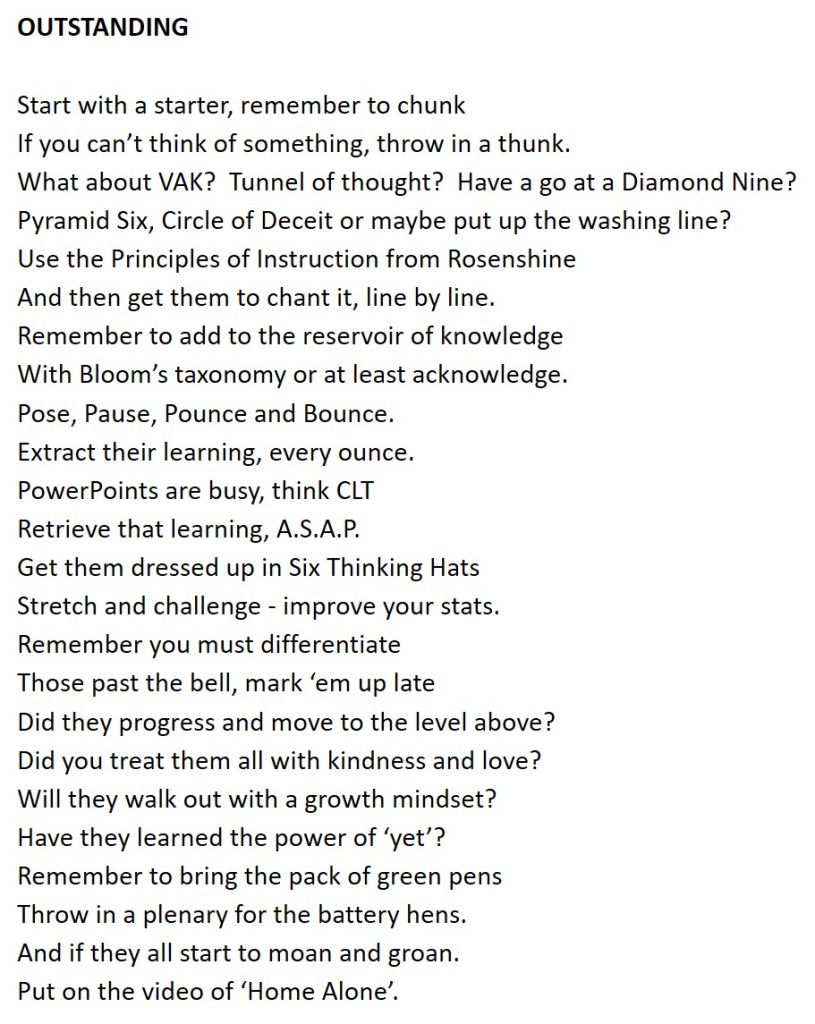
WHO’S WASHING LINE IS IT ANYWAY?

I think teachers are quite a cynical bunch. Whenever there is a discussion about a new teaching approach, there are many quizzical looks, some discussion and then most carry on regardless. This is why I’m always surprised to hear that our whole profession was supposedly taken over at some point by ‘edutainment’ and that we were all progressives being guides from the side.

In many respects I blame Daisy Christodolou’s book ‘7 Myths…’ and I’ve never understood why it has been heralded as an absolute game changer for the profession. In the book she uses Ofsted reports and Ofsted observed lessons as a way of understanding what is considered to be good teaching. I understand the reasoning because what Ofsted wants, schools try to deliver in order to get a good rating for their school. Unfortunately though, if you’ve only been in teaching for a short space of time, you would have missed how most teachers ‘gamed the system’ in order to get a positive lesson review and then went back to their ‘normal’ teaching, which clearly they thought was better than what Ofsted was looking for.

For example, in the build up to an Ofsted inspection, there would be much chat in a staffroom about what Ofsted was looking for at that particular time. Most staff (who want their school to get a good rating) toe the line and jazz up their lesson by bunging in whatever the latest craze was. After that moment, they would go back to what they would normally do, which is delivering knowledge from the front, with a few activities chucked in to see whether students understood or not. Most teachers would also do this if SLT came to watch because (again) it might be expected of them to follow Ofsted guidelines and most teachers want a ‘good’ lesson observation. Therefore, out of the 700 lessons or so each year that I might teach, 4 or 5 lessons might get observed where I change my teaching to suit Ofsted criteria – that’s 0.7% of my lessons. If you think reading observations of my lessons gives you an indication of the way I teach, then you would be very much mistaken and yet, for me (and obviously you can disagree with me) that’s exactly what Daisy does in her book. Ofsted inspections/reports are not a good proxy for how most classroom teachers teach and therefore she has spread a myth about how all schools were using ‘edutainment’ or ‘student centred learning’ to teach. The fact that teachers did change their methods for those lessons can be criticised and is a bit crazy but because it was such a miniscule part of their teaching life, it wasn’t a big deal. As soon as Ofsted left or SLT stopped observing, most got on and taught their lessons as they always did – delivering knowledge from the front. And you had to do that because it was the most efficient way of getting through the specification/curriculum in the time that was available to you. This means you couldn’t ‘edutain’ the whole time even if you wanted to!

Having said all that, if you look closely at a lot of teaching methods that are now heavily criticised, I’d argue that the majority of them are not as bad as everyone makes them out to be. As I’ve said, teachers are cynical folk so what would normally happen is that they might try something once (because they’ve been told to and they want to tick the box) and then carry on but that very nature of trying something, can get you thinking about your teaching. Take the much derided washing line. We were all given one at school and it must have taken an AST ages to put them together but I know that I used mine for a sorting activity related to business ratios for Tesco and Sainsburys. The time it took for the students to get up and hang up their ratios ultimately wasn’t really worth it but (and this is the key bit) it did make me think about sorting activities more generally to improve my students’ evaluation skills. The same for VAK – yes…I’ve done a questionnaire and had to think about visual, auditory and kinaesthetic approaches to learning but although there is no science backing it up, I’m not as aggrieved at VAK as most people are these days because it started a conversation in my school about teaching more generally. By investigating the so called different approaches, you actually came across methods (maybe accidentally) that did have some sort of scientific evidence behind it, such as dual coding and the use of mind mapping. Diamond Nine and Pyramid Sixes were all about trying to get students to think about justifying their responses. Growth Mindset is all about trying to get students to appreciate that with hard work and deliberate practice, they can get better at a subject. It’s not just sloganism and posters on walls, most teachers who advocate a ‘growth mindset’ will show students how they can improve…they don’t leave them hanging as many critics of growth mindset suggest and just say ‘put more effort in’, although for some students that would help!

Most teachers are cynical and question everything but also most teachers I know, do want to get better and be the best teacher that they can be. Therefore when new methods do come along, they look at it with a quizzical eye, give it a go and if it doesn’t work, they dump it and if they think it has some merit, they’ll use it.  But at the heart of all teaching is the knowledge that the students have to know in order to past their exams.  That in itself is quite a cynical approach to teaching but ultimately it is realistic and that’s why it’s a nonsense to suggest that delivering knowledge somehow went missing during the supposedly ‘progressive’ years.

And what happened to my washing line? Well funnily enough, I was lucky enough to go on a school trip to Tanzania where I actually used my washing line as a washing line! It worked a treat.
FINDING THE BEST STICKING PLASTERS

In a blog about complexity in education, I quoted Elinor Ostrom, who was the first woman to win the Nobel Prize in Economics. It was therefore great to see this week that another woman has finally won the Nobel Prize again and her name is Esther Duflo. She won the award alongside her husband Abhijit Banerjee and Michael Kremer and at the age of 46 is the youngest person ever to win the award. They won the award ‘for their experimental approach to alleviating global poverty.’ and you can read about their achievement here. Duflo and Banerjee wrote a book as well about their experiences a few years back and it is well worth a read – it’s called ‘Poor Economics’.

Their experimental approach has been their use of RCTs (Randomised Controlled Trials) to discover what programmes are most effective in order to alleviate poverty. Clearly it makes sense to do these trials or otherwise you could be spending a lot of aid money on programmes that don’t work and as we know in economics, there are finite resources and therefore we have to spend them as efficiently as possible but this doesn’t mean that their approach hasn’t been criticised.

Much of their work is looking at small scale projects and seeing whether the interventions work. This is perfectly acceptable of course but it only works on a micro level and avoids the huge structural issues that cause global poverty. This is summed up in this article by a number of rival economists (with fellow Nobel Prize winners amongst them) and this excellent article in the Tribune India by Pritam Singh that also discusses the dubious ethics of the RCT approach. In fact the last paragraph is a real gem – ‘The reason this approach is popular with politicians, aid agencies and global policy-makers is that they want to see quick results of their specific interventions rather than troubling themselves with the structural causes of poverty and the transformational changes required to deal with mass poverty.’

This final paragraph is important because it can clearly relate to education and the move towards a more evidence informed approach. In 2010 Michael Gove (then Secretary of State for Education) set up the EEF (Education Endowment Foundation) at the cost of £125 million to investigate ‘what works’ in education. Once again this is a laudable idea and since then they have run a number of RCTs (although some of these have been criticised), which have then been used to provide a toolkit for teaching and learning that schools can look at in order to prioritise their spending.

I have always found it a fascinating read and it’s also interesting to see how the data has changed over time. For example, I remember when it was first released and the data on teaching assistants was pretty poor (they were seen as high cost with low impact) and being a governor of a Primary School at the time, I remember the Head’s eyes lighting up as he had the evidence for reducing the wage bill. Over time, the data has improved for teaching assistants and therefore you do wonder how many decisions were made on such imperfect data. It’s also fascinating to see what’s ignored as well. Having a uniform has no impact whatsoever on education attainment but you rarely see many people arguing for the end of uniforms based on the evidence.

However, let’s go back to that Pritam Singh’s quote. At the time of Gove introducing the EEF to evaluate ‘what works’ in education, the government were slowly cutting back huge amounts of money in schools. Yes you could argue that the EEF was needed because now schools had to do ‘more with less’ but not only was school funding being cut but the whole country was being forced to endure the perils of austerity. To use a medical analogy, it was as if Gove had given funding to a nurse to find the best plaster to deal with a patient whose leg had been chopped off!

Therefore we can see a similarity between trying to deal with global poverty as with trying to solve the issues in education. The government likes the EEF/RCT approach because they can see quick results with specific interventions rather than troubling themselves with the structural causes of educational issues. It’s easier for Nick Gibb (Minister of State for Schools) to point to a study about the banning of mobile phones in schools or the work of researchED rather than discuss the issues of poverty that might cause behavioural problems in schools or the lack of funding for policing that has led to schools dealing with issues surrounding ‘county lines’. It’s also quite interesting to see that despite the huge increase in evidence informed practice that have been supported by these RCTs, the impact on results has been negligible because no one in government wants to tackle the structural issue of the bell curve when it comes to the distribution of exam results.

So it’s great that another woman has won the Nobel Prize in Economics and this is hugely important for diversity in the subject but I also think it’s great that Duflo winning it (alongside Banerjee and Kremer) has got the world thinking and discussing the effectiveness of RCTs in all areas of life and whether that truly is the best way of solving big problems.

Finding the Fun

Over the last year or so you may have watched a Katelyn Ohashi gymnastic floor display but if not, you should watch one. Do it now. Click the link. They are great! They are great for a number of reasons. Clearly when you watch one, you can see the incredible skills involved and the strength she must have to pull off some of those moves but my favourite bit is the sheer joy on her face. Not only does she radiate joy but those watching her do so as well. Everybody is enthralled with what’s going on and when she gets the perfect score, the place erupts. It’s very cheesy American but so what? It’s great!

When you are watching Katelyn you start thinking about why she isn’t representing the USA at the Olympics or at the World Championships because of how good she is. Thankfully the BBC has provided us with the answer in this excellent little report that’s all about her. https://www.bbc.co.uk/sport/av/gymnastics/49856691

What we discover is that she fell out of love with gymnastics. At twelve years of age! She was rising up through the ranks and then it all got too much. What she needed to do was rediscover her love for gymnastics, so she went off to college, found validation in stuff other than gymnastics and then got back into it on her own terms. It’s a fascinating story and one we can learn a lot from.

If I think about my career, which I would assume mirror others, you start in the classroom and then slowly progress upwards. You have to do this in many respects to get more money and you have to show leadership if you want to move onto the Upper Pay scales. I went through a standard path by becoming Head of Subject, then Head of Faculty, whilst dipping my toes into other areas such as Head of Student Voice, Senior Tutor in the Sixth Form and Head of House. As you progress, you want to try a bit of everything to see whether you want to go down a pastoral route or a curriculum route. I always had a vision of being an Assistant Head and then a Deputy and I was lucky enough to be given a secondment onto the Senior Leadership Team at my school. However, the more I moved up, the more I felt removed from what I originally got into teaching for and that was being in the classroom, trying to get my students to love my subject as much as I did. As you move up, you find yourself in more meetings, with more paperwork, with less time to prepare for your bread and butter, which then makes you feel guilty about not delivering the quality the students deserve. You suddenly realise, a bit like Katelyn, that you stopped enjoying what you do. You’ve lost the fun.

So what did I do? Well…I didn’t leave teaching (which I think some would do) but went back down the ranks to unshackle me from all of the stuff that was boring the death out of me and just focused on the classroom. My pay went down but I didn’t mind because I was much happier and that happiness filters through to the students. Just like those watching Katelyn, your joy becomes their joy and that lends itself to a much better learning environment.

I’m obviously lucky that I could take the hit on pay and I know that it’s much harder for young teachers coming through today with the state of the housing market, along with student debt and the way teacher pay stagnated for a number of years. The point I’m trying to make though is that we need to find ways of keeping the joy in teachers’ lives because if we don’t, then the recruitment crisis will get worse. Sometimes we might want to reflect, like Katelyn did, why we are miserable in our job and take bold steps to deal with it.

I think there is a culture in teaching whereby if you want to stay in the classroom, then you are not seen as being ambitious and then not respected as much but we have to remember the humble classroom teacher is the bedrock of a school. I have had colleagues ask me why being a really good classroom teacher is not good enough reason to get a pay rise. They feel they have to do something that they know they won’t enjoy or won’t be good at in order to go up the pay scale. That sounds like a very perverse situation to be in and is surely not good for the individual or for the school.

The AST role was designed to keep those great teachers in the classroom through higher pay but they were expected to share their experience in other classes and in other schools, taking them OUT of the classroom. Obviously we just need to have higher pay for teachers that means classroom teachers don’t feel the need to move up the greasy pole. Clearly there are lots of teachers who want to have more responsibility and they should be rewarded for that but I see a lot of misery from those in higher positions because they are not prioritising what they genuinely got into teaching for – the love of their subject and the joy of passing it on.

Maybe the fun can be found in extra funding for schools!

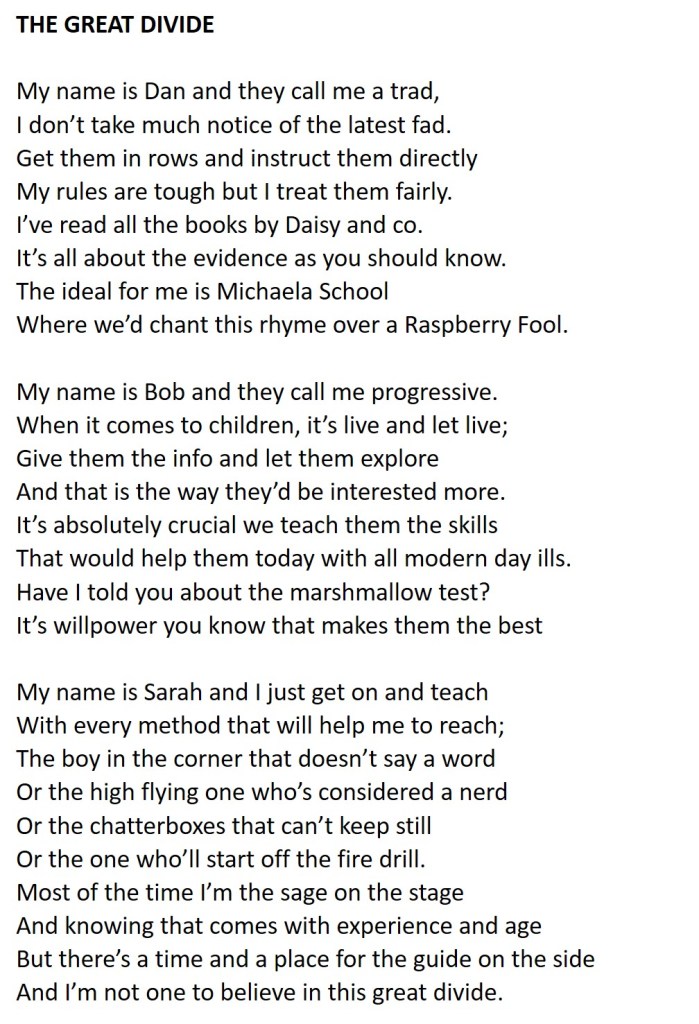
THE GREAT DIVIDE – Teaching and Complexity on National Poetry Day

Currently I’ve been reading books and articles on Elinor Ostrom for the podcast I do with my fellow teacher Pete – it’s called Economics In Ten, check it out! This first woman to win the Economics Nobel Prize (which isn’t actually an official Nobel Prize) is a fascinating economist. One of the reason she’s a fascinating economist is that she’s really not an economist. She wasn’t allowed to study Economics as she hadn’t done the Maths. She wasn’t allowed to do the Maths because she was a girl! She did eventually study economics in a roundabout way through her Political Science degree and her work.

The main takeaway from reading up on her is that she understood that problems were complex. There were no simple answers. There is no panacea! That was one of her catchphrases. This is interesting in economics because a lot of the times we want the solution to be either market based or government based. Elinor pointed out that there could be another way through the use of common ownership and control within small communities. The key was to get out in the field, learn a lot about the environment, speak to those involved and come up with solutions agreed by those involved.

In teaching, we seem to be in a situation where there are just two solutions offered up to the problems in education. One is considered the traditional approach to teaching and the other is the progressive approach. You may have own your ideas what these mean but if not, I’m sure you can discover it quite easily online or on Twitter. In the educational world, the battle lines are drawn and soon the fighting starts between what method to use is.

But what Elinor said of the problems in economics is also the case in education. A one-size fits all approach, whether it is traditional or progressive, is not always the best approach, given what is going on at ground level. This could be the case not just for schools but also for classrooms as well. Most teachers appreciate this and will use different methods according to what they think is best for their students at that particular moment in time. On Twitter some educationalists will criticise others for what they are doing and yet they have no idea of the context of the situation. They think their way is the right way because it works for them in their school but sometimes, it might not and who should be the judge of that in other schools? Those that work there!

Dylan Wiliam’s quote about ‘everything works somewhere…’ is often seen as a get out clause for some people but in relation to Elinor’s work, it’s one of the most important bits of information a new teacher should be given. I think they should be encouraged to experiment with different techniques to find out what works best for them, in particular settings. We know that some things will work p.1 on a Monday morning but won’t work p.5 on Friday with the same class but we need to trust teachers on the ground to work that out, develop their teaching toolkit and get them to appreciate that it doesn’t have to be one way or the highway! We need to appreciate complexity in the teaching world and tackle it accordingly.

I hope you liked the poem.

GRAPHIC NOVELS – THEY’RE BIG AND THEY’RE CLEVER!

I’m a huge fan of graphic novels and when I read this twitter thread from @kmarch67 it made me incredibly sad and rather angry. I’ve already written about the difficulty of getting students reading for pleasure but when teachers are telling students they shouldn’t read graphic novels, then they are only making the situation worse. One has to assume that these teachers do not understand the great depth in graphic novel writing that is out there and haven’t read many of them or otherwise they wouldn’t say such a thing. I would also argue that some picture books (that wouldn’t necessarily be considered graphic novels) can also offer complexity, through the combination of words and images they convey but more on that later.

In many grown-up minds, cartoons or comics are associated with their childhood and therefore an availability bias occurs. They just remember them as being infantile and therefore regard them as so when someone mentions they are reading a comic book. It’s a classic rule of thumb but as behavioural economists know, this is where bad decisions are made and I’d argue that a teacher telling a student that they should not read a graphic novel is definitely a bad decision.

Even the wider book community has acknowledged the power of graphic novels, as shown by the inclusion of Nick Drnaso’s ‘Sabrina’ in the 2018 Booker Prize list. The story of the murder of a woman named Sabrina is an incredible read, which is very haunting and gets you thinking about the state of the world in an era of ‘fake news’.

Film and TV companies like Netflix also seem to acknowledge that they make great stories as shown by the continual number of adaptations of excellent graphic novels. Most of them haven’t really worked as films but the ideas that are conveyed in the books by Alan Moore are incredibly thought provoking and potentially inspiring, as shown by the many ‘V for Vendetta’ masks worn when there are marches against the 1%.

You could also argue that reading classic novels in graphic novel form can work from a dual-coding angle as the combination of words and pictures is an effective tool to learn, as explained here by the learning scientists. The Shakespeare Manga series can certainly work in this regard for studying set texts like ‘The Merchant of Venice’ or ‘Hamlet’ in English. I love these books and when I drive the A Level English students to Stratford-Upon-Avon for their annual trip to the RSA, I’ll often read the Manga version of the play we are seeing in order to fully understand what’s going on. The Manga Shakespeare books are produced by Self Made Hero and they have a superb collection of books and I can heartily recommend the ‘Castro’ biography, ‘Heart of Darkness’ (that eventually made me read the actual book – it was a gateway drug!) and ‘Tetris’, the story of the classic Nintendo game.

There are many great graphic novels but I wanted to mention picture books as well, that can also have huge amounts of depth. Take Dr Seuss’ ‘The Butter Battle Book’ which is his satire on the ‘cold war’ or Michael Rosen’s incredible study of grief in his book ‘Sad Book’. These are two books that can be read at any stage of life and provide the reader with opportunities to reflect. Why would you stop children reading them? We often complain that children are too quick to grow up and then force them away from reading what they want! It doesn’t make sense. Let them love all books and especially graphic novels!

For graphic novel enthusiasts, here are some recommended reads related to some subjects.

Economics – Supercrash by Darryl Cunningham, Deogratias by Stassen and Red Son by Mark Millar (as featured in the EconomicsInTen podcast on Karl Marx alongside Martin Rowson’s Communist Manifesto)

History – Barefoot Gen by Keiji, Maus by Art Spiegelman and Peterloo by Polyp

Media Studies/Sociology – Filmish by Edward Ross and The Influencing Machine by Brooke Gladstone

Geography – Illegal by Eoin Colfer and Andrew Donkin, As The World Burns by Jensen and McMillan

Psychology – Psychiatric Tales by Darryl Cunningham and Neurocomic by Farinella

Philosophy – Logicomix by Doxiadis and Papadimitriou

English/Drama – 99 Ways To Tell A Story by Matt Madden

If you are looking for anything to read about how to produce graphic novels/cartoons, then you can’t go far wrong than reading Scott McCloud’s books on the subject, including Making Comics and Understanding Comics.

I would also heartily recommend checking out Icon Books as their Graphic Guide/Introducing series are excellent and cover almost every subject imaginable. I often use their ‘Introducing Economics’ book to quickly look up something on my subject. ENJOY!!!

*Footnote: Most of these book links connect to Amazon but please do the reverse of what you would normally do and browse on Amazon and then buy on the high street from a proper book shop!

The GUILT of REMARKS and the QUESTION of INEQUALITY and SUBJECTIVITY

I have just had a student go up from a grade 6 to an 8 in Economics. I’m delighted for the student and would argue that the mark now reflects their skills as an economist. In fact, I have had 3 or 4 students go up grades across GCSE and A Level and expect more to do so.

As teachers we all know about the problems surrounding the subjectivity of marking in particular subjects. We also know that exam boards take great care in trying to make sure that all the marking is standardised and put features in place to stop discrepancies happening but I just keep on thinking…a 6 to an 8! In one question, they went from 1 mark out of 6 to 5 marks out of 6. This means the first examiner thought they had displayed some knowledge and the more senior examiner thought that they had shown good knowledge, application, analysis and evaluation!

In Economics, I can understand (sort of) how this happens. At a training event for the new specification, we were shown exemplars and for the longer written answers, there was disagreement over nearly all the marks given. It’s a game of hit and miss and it has been like it for years in Economics. I once saw an A Level student go from 97/120 to 114/120 for a particular paper and I put this down to the fact that he was so good, that the original examiner might not have fully understood the points he was making or appreciated the complexity of his argument. But ultimately, Economics is subjective and I’m sure many other subject teachers are just as aware of how subjective their subjects are and the problems this produces.

But a 6 to an 8. It’s very rare you skip two grades and all it makes me think about is how lucky I am that I’m in a school with relatively wealthy parents that will take a punt on getting a remark. And we know this will be happening up and down the country, where rich parents will question the grade and spend a small fortune trying to get higher grades for their children. As a parent, I appreciate this point as you want to know that the examiner has got it right and you want the best for your child but I keep on thinking about the not so wealthy parents. The ones who can’t afford the upfront fee of getting a remark. Yes you get the money back if the grade goes up but for some households, finding £40 for each remark is a considerable cost. Also many children from poorer backgrounds may not have the confidence of questioning their grade and therefore accept it, even if they feel they should have done better. Plus they might not want to ask their cash-strapped parents for a remark.

Therefore I’m lucky and my students are lucky but it’s not right is it? When the league tables are produced, this is just another additional advantage that schools in wealthier areas have. But forget about league tables, more importantly this can have a huge impact on a student’s future pathway. Many schools will set entry requirements for Sixth Form or for particular courses and there might be many students out there who have not been able to access a course or an establishment due to some hugely subjective marking or because they couldn’t afford to challenge the marks. Many students might not choose a subject because they think they are not as good at it when in actual fact they are! If you have got all 8s in your subjects and then get a 6 in Economics, why choose Economics? According to chaos theory, this ‘sliding doors’ moment could have a significant impact much further down the line.

Ultimately in some subjects, subjectivity is always going to be there and the cost of remarks does create a two tier system. Unfortunately this blog doesn’t really offer any answers related to this problem. Maybe schools could think more about using pupil premium money to support those students getting remarks if they are borderline but when a student goes from a 6 to an 8, the borderline point doesn’t necessarily hold anymore. 6 to 8 is no big deal but going from a 2 to a 4 or a 3 to a 5 certainly is.

Can the exam boards be doing any more? Probably but there will always be human error and unless Economics finally solves Harry Truman’s problem of finding a ‘one armed economist’ there will always be a difference of opinion. At A Level, I feel there has been an increase in Maths questions due to their objectivity but if you have chosen Economics, it shouldn’t turn into a Maths paper. The rise of multiple choice questions has also helped from an objective point of view at GCSE but this still hasn’t stopped an exam paper being hugely under-marked.

The one thing I would say though (to end on a positive) is that most students do get the results their effort and application deserve but sometimes, when you see a 6 to 8 movement, you start questioning everything (in terms of the way that you have prepared students for exams, etc.) and yet I’m a lucky one and so is my student. I have to keep on remembering that.

IN DEFENCE OF MOBILE PHONES

At the start of a new term, there has been renewed calls for schools to ban mobile phones. As we can see in this BBC news article, just under half of parents want mobile phones banned in schools, according to a survey carried out by uSwitch. Many schools have already implemented a ban and it seems very clear that the government would be in favour of banning mobile phones, in fact, Nick Gibb has stated this quite clearly.

I can appreciate the problem of mobile phones in schools and have delivered an assembly about them, in the disguise of a new drug called ‘Amprohnest’. If anybody would like the PPT of that assembly, then feel free to contact me via Twitter @MrGSimpson. Despite my reservations though, I certainly would not want them banned in school as I see this mini-computer as a powerful tool for learning.

In fact, I think it is our duty to teach the students how to deal with their mobile phone habit, as Paul Howard-Jones argues in the news article above. Just because we ban them from school does not mean they go away, it just means that we potentially defer the ‘bad’ behaviour. So let us deal with the issue in school rather than ignoring it through banning them. Let us teach them how to self-regulate and understand when it is a good time to use mobile phones and a bad time.

How can schools claim to have well-behaved students by taking away mobile phones which they have in their lives outside of schools? Surely you have done your job well as a school if a student can use them in an appropriate manner? Bullying used to exist without mobile phones and phones may have made this easier but bullying is wrong full stop, so we must teach our students that this is wrong no matter how it is done. Some argue that it is a distraction in class but students can be distracted by anything and we need to teach them how to concentrate on what the teacher is saying or the task they have been asked to do. When modern calculators first entered schools, boys up and down the country were using them to spell the word ‘BOOBIES’, does that mean calculators should have been banned? Of course not, as they are an extremely powerful aid to learning. As teachers, we have to make sure students have the right moral code and banning things will not help us do this.

Anyway, here are some reasons why I think mobile phones are good in the classroom:

  1. You can use them for retrieval learning activities, such as the quizzes I have created on Kahoot. Not all schools will have Chromebooks or iPads to hand and the little mini-computer in their pocket is really good for this kind of stuff. Kahoot is great as it automatically records the results for you and the students like the competitive element of it.
  2. As an Economics teacher, there are often times that I want to find out some information that would support the learning that I’m doing or just to double check that I haven’t made a mistake. I have no qualms about students helping me with this by using their mobile phones if it is during a discussion part of the lesson.
  3. Sometimes, I might want them to take photos and embed them into an activity they are doing and obviously mobile phones are excellent for this, as well as making videos. If you download a program like PicPac, you can also make stop-go animations. I recently saw this being used in a Geography lesson to explain a particular geographical phenomenon.
  4. In the 6th Form I want to encourage my students to attend Think Tank events or lectures and there are some times (not often) when I encourage them to sign up in lesson time in order for them to guarantee a spot before they all go.
  5. In a very simple way, they can be used as a spellchecker and as a calculator. Why carry around lots of different stuff when one thing will do?

If mobile phones become a problem in your lesson, then just get better at dealing with bad behaviour in your lessons. If there are clear rules about mobile phones in school and in your lessons, enforce them but at the same time, teach them the reasons why those rules exist. Encourage them to self-regulate and show them how enjoyable being offline can be.

From someone who teachers mainly 6th form, I’m actually more concerned about the rise of laptops than mobile phones, as shown in the studies about the negative impact of laptops on learning. These seem to be a much more respected tool for learning and yet could be far more damaging. I am not a big fan of laptops in lessons and yet they seem to be encouraged but this could be a case of ‘whataboutery’ and therefore I’ll just stick to discussing mobile phones.

As with most arguments in education, the mobile phone debate is much more nuanced than it first appears from the headlines. I believe that the benefits of having the opportunity to use mobile phones in lessons outweigh the costs and would not like to see them banned. I think it should come down to the personal choice of the teacher but I also understand how that might cause problems with consistency across a school. It’s no doubt a debate that will continue but I genuinely think that banning mobile phones in school is not going to help with the wider societal issues caused by them. Education is the key to dealing with most problems, so let’s educate students about mobile phone use in schools so that they can be better citizens in the future outside of it.

SAY ‘NO’ TO HOMEWORK – The homework debate.

A couple of years ago, my colleague and I were asked to have a debate about homework to ‘get the conversation started’. I chose to argue against homework and here is what I said. I post it now as there seems to be some discussion about the future of homework due to Ofsted cutting homework checks.

Good morning everybody.  I want to put my case against homework using a holy trinity approach…not the Father, Son and the Holy Ghost but the teacher, the parent and most obviously the student, who should be at the heart of everything we do.

So I will start with us as teachers. We have had continual discussions at this school about workload and as a profession we should be looking for solutions to address the situation that has seen the numbers leaving teaching increase by 11% over the past 3 years. Sometimes that means challenging ‘conventional wisdom’.

Homework is a time stealer and as I’ll come to later on, it gives us a false impression of students and is therefore not ‘fit for purpose’. This is particularly the case with a homework timetable. A study in 2004 by Hallam showed that the setting of homework was poor due to teachers feeling pressurised, regardless of the stage of work that has been reached in class, to set homework on a stated day.  Creating homework takes time and another problem we have is that research shows that students only see the value of homework if it is monitored and marked by the teacher. Research by Keys in 1995 showed that multiple feedback was deemed to be best but how much time do we have?  Surely we can just do this with classroom assessments which has the added benefit of knowing that the work handed in has actually been done by the student and not someone else. The opportunity cost of setting and marking homework is huge and the time is surely better spent becoming a better teacher (preparing ‘outstanding’ lessons) or looking after your emotional well-being.  In a recent survey 83% of teachers had reported workplace stress and 89% of teachers said that the key area was workload. I argue homework adds to this enormously.

Now on to parents. And there are many parents of students at this school in this room and I’m sure nearly all of them will recognise a scenario I had last Sunday evening where I found myself berating my kids as they suddenly had homework to do just before bedtime. Not only did it raise my stress levels as I tried to get them to do the work, I also found myself aiding and abetting them. Suddenly their success (hopefully) was my success.  But they are the lucky ones…I consider myself to be a mildly supportive parent and I like to think I can help them with different areas of study.  Imagine the frustration you must feel when you don’t know how to help them or haven’t got time to help them. Researchers from Brown University found that stress and tension (as reported by the parents) increased most when parents perceived themselves as unable to help with homework, when the child disliked doing the homework and when the homework caused arguments, either between the child and the adults or among the adults in the household.  Why do schools create a scenario that creates additional stress for parents on top of the stress they probably have from their own jobs?

Finally students.  I asked my form, how many of them thought homework helped them learn. I had 8 positive responses but even they were not that positive. I asked my form whether homework was their biggest stress factor at school. 18 students put their hands up. We are creating a nation where mental illness amongst our children is on the rise. A recent survey by the Association of School and College Leaders showed that 55% of school leaders had seen a large rise in pupils with anxiety and stress.  Over the past 5 years, 79% of Heads saw an increase in self harm or suicidal thoughts. A study conducted by Stanford Graduate School of Education found that excessive homework causes high stress levels and physical health problems.  Now, you may say that the important word there is excessive and we have limits on our homework activities but do we really.  Do students really stop after 20 minutes?  And do we really know what a 20 minute homework looks like?  In a recent column by Oliver Burkeman, I read about ‘Hofstadter’s Law’ which states that things always take longer than you think EVEN WHEN you take into account ‘Hofstadter’s Law’. In other words: you will underestimate how much time a task requires, even when you know that’s what you always do and try to plan accordingly.  But remember…that’s for us!  We’re trying to second guess how long an activity takes for a student who has only just learnt some of the information we are asking them to do a homework on OR in some cases, they are finding out something that they’ve never even been taught about. Is that flipped learning?  I will tell you now…your 20 minutes is not their 20 minutes. Einstein was right!!!  Therefore if we genuinely care about our students and their well-being, we need to give them time to be themselves. Let kids be kids!  What’s wrong with play?  Learning will take place but in a different context.

But you may argue that by not setting them homework we let them down in the future because they do not get the grades that they want to, in order to have a ‘truly useful life’. But I will disagree with any data related to the power of homework on learning.  Why?  Simply put, the data is pretty ambiguous. A recent report from Victoria, Australia came up with this conclusion after three days of public inquiry – ‘it is not possible from the available data to make unequivocal statements about the effectiveness of homework overall in assisting student learning’.  The main reason behind this has got to be because correlation does not mean causation. But there are others…how do we really know how much homework kids do? Most studies claim they know how much homework students do but we all know that a student may have looked to have done their homework but haven’t.  As a student in my form said ‘everyone copies homework’ and with Snapchat/Instagram/Instant Messaging, this spreading of information gets easier and easier to do. That’s why they don’t see the value of homework as a learning tool because it provides false information.  I have a number of other reasons why data on homework is so poor but time limits me.  Even if we DO agree that there are positive effects from homework, we then have to reflect whether the payoff for working several more hours is worthwhile on a wider scale.  There are many reports that show that reading more widely boosts performance, doing extra-curricular activities boost performance and so on.  I would argue that these activities should be encouraged more and from a well-being perspective, offer much greater value than anything homework can offer.  All work and no play makes Jack a dull boy.

So there you have it…the case against homework.  And the common theme across all three stakeholders is that of well-being.  The current school model is broken and we have to fix it.  Scrapping homework is the first step in building a more sustainable schooling model.

Exam Results and Negative Data

In 2012, Ben Goldacre made a really interesting TED talk called ‘What doctors don’t know about the drugs they prescribe’ and you can watch it here. I used to show it to my students because I thought they should know about it. Ben has gone off the radar a bit but I’m aware that when there was a big push behind the use of evidence in education, he was at the forefront of it. In fact he wrote this for the Department for Education after being asked by Michael Gove to explore the role of teachers in research.

On results day (and in the aftermath), I’m sure that if you were on Twitter, then you would have read about the excellent results Michaela School have achieved. Even if you were not on Twitter, you probably would have heard about them because Katharine Birbalsingh is a PR machine and many people wanted to draw attention to the positive results. And why not? They are great results and the school should be proud of their achievements. However, GCSE results (and A-Level) are pretty much a zero-sum game. That means as some schools go up, others must go down due to comparative judgement and the bell curve distribution of results.

How does this relate to Ben Goldacre and his fascinating talk? I know Twitter accounts and retweets aren’t academic journals and teachers aren’t researchers but if you were looking at the best way to get results after GCSEs, the only information you have are the positive results. And that makes sense…I mean, who would go on Twitter and say ‘our school saw a decline in our GCSE results today and those achieving 4-9, went down by 12%’?  But in order to make any sensible decisions on what you should do in school (or in the case of doctors prescribing medicine) you need the negative data as well as the positive data.

What if a school had tried to implement the Michaela Way but had found that in their school it was much more difficult to do due to the size of the year group? Or they couldn’t be as choosy on the intake because it wasn’t over-subscribed? Or the school buildings were designed in a way that they couldn’t have the communal lunchtimes that Michaela had? Or that they had gone full on Rosenshine but it just wasn’t working for some reason or another?

This isn’t making excuses for schools that have failed. What would be interesting is to go beyond the happy results in Twitter and find out what was going on in schools where they had a decline in performance. Or at least have an honest conversation about it so that there could be negative data included in the discussion. To be honest, they might have improved but the system only allows a certain amount of students to get a certain amount of grades (as discussed in this @teacherhead blog) but that in itself would prove useful. We would have evidence to suggest that the way grades are given out should change. It’s something I mention a lot on Twitter about how you have to keep moving forward in order to stand still and that seems rather unfair for our students.

I think about it from my own personal point of view. Over the past two years (and more) I’ve been inspired by the Learning Scientists and have introduced lots of retrieval learning into my teaching. In fact, I discuss meta-cognition with the students and go through the 6 effective learning strategies with them. I encourage them to elaborate, dual code, interleave, space their learning and so on and I stand at the front and give direct instruction.

So what happened to my results this year after two years of following the research? They went down. Not by much but they went down. Obviously there could be a number of reasons why this is the case but when you follow the evidence, you expect to see some improvement. Maybe I was just doing all of this anyway without me formally realising it (I probably was) or our students start from a very high base line (they do) and therefore the gains made are always going to be marginal but it does make me think about the number of schools (or teachers) out there who have made changes to their teaching and learning (following the research) and have actually seen no improvement.

It takes a brave teacher/researcher to reveal their negative data but if we want to move the profession onwards, we need to have all the information and I look forward to the time that someone puts a big banner on Twitter that hails disastrous results!!!

Reading for Capitalist Pleasure

In Yanis Varoufakis’ excellent and very accessible economics book ‘Talking to My Daughter About the Economy’ he states that the capitalist system has led to a situation where exchange values now triumph over experiential values.  What does this mean? And why is that so problematic for teachers when encouraging students to read?

Before I get onto that though, I want to tell you about another book that I was reading at the same time as Yanis’ book and that was Peter Crouch’s ‘How To Be A Footballer’.  It’s quite an interesting read but what most struck me was when he discussed the issue of signing autographs. I have to admit, I’ve been one of those people waiting at the gates with my son, hoping to get a famous footballer’s autograph. When you finally get one, you walk off with a little skip in your step knowing that it has made your boy’s day. At home, we used to then stick them into a book and flick through all the pages and play ‘Six Degrees of Separation’.  I also did this when I was younger, in fact my first autograph was one by Graham Miles at Pontins. If you know who he is, then congratulations, you’re as old as me!

The value for my son and I of getting an autograph was the experience of actually meeting one of the players (or at least being close to them) and having a record of it. At no point were we thinking about the exchange value of that autograph. At no point did we think ‘Great! We’ve got Trevor Brooking’s autograph, let’s flog it on Ebay!’ but if you read Peter Crouch’s book, that is what he suggests is now the norm in the autograph world. It has become a market. One where a person will turn up with a photo of Crouch or a shirt of Crouch and get him to sign it in the knowledge that it will have some sort of exchange value. When Crouch started ignoring the adults, they’d send their kids in to get the autographs. Now he does the footballer thing and tries not to notice the autograph hunters which, if you think about it, is incredibly sad.

Hopefully that explains the difference between exchange values and experiential value and if you think about it, Yanis is right. Due to the capitalist system, everything nowadays must have an exchange value or there is no point in doing it within a market system.

And this is problem for teachers. Reading a book for students is now no longer about the experience of escaping into another world and seeing things from another person’s perspective or learning new things, it’s all about the exchange value of reading a book. Will it help me get a better grade at GCSE or A Level? Will it look good on my personal statement for UCAS? Will it help me get a job? And in many respects, we as teachers facilitate that viewpoint. I certainly do although I try desperately not to.

This is why I get mildly gobsmacked these days when I see one of my students reading a book that has nothing to do with their studies.  It is such a rare occurrence I have to stop and talk to them about it. And mostly it’s girls.

So how do we buck the system in school when ultimately we have an economic system that Yanis writes so beautifully about in his book? Where exchange value has triumphed over experiential value. In a world where the market system has been introduced into the school system through league tables and plenty of competition. Where time is at such a premium for students that reading for pleasure seems an utter waste of time.

I don’t think there are any easy answers…obviously start them young but even then, the drop-off at GCSE and A-Level is obvious to see. Role modelling is clearly important. Even though I’m an Economics teacher and I do read a lot of economics books, I share my love of graphic novels with my students and the poetry books I have been reading – check out Raymond Antrobus! I bring in the majority of books that I read into the classroom for students to take so that there is no financial barrier to reading. I liked reading this blog about a ‘Read Aloud’ programme that was introduced at a school by @MissJoT and I think the books chosen are great as it’s not obvious that they are about exchange value. Any communal discussion about books between students (and staff) has to be a good thing and should encourage wider reading. Having a great library (and librarian) obviously helps and schools need to make sure that funding in that area doesn’t get cut so that they can be pro-active in promoting reading and if that costs a bit of money by getting an author in, then so be it.

I’m sure there are probably lots of good things going on out there in schools with regards ‘reading for pleasure’ and I’d love to hear them but as Yanis points out in his book, the capitalist system has changed hugely the way we think about a lot of things, be it collecting autographs or reading books and that is something that teachers will always be fighting against. The answer simply might be just to give in and go with the flow…now who wants a Trevor Brooking signed photo for a fiver?

Design a site like this with WordPress.com
Get started