PICKING WINNERS IS A MONKEY’S GAME – Predicted Grades

As a teacher of Economics, I try to encourage my students to get involved in the Student Investor Challenge. It’s a fun activity where teams of 4 have to invest virtual money on the London Stock Exchange and make as much money as possible through buying and selling at the right time. If they beat all of their competitors, they win a trip to New York! The original competition used to also include two non-school teams – a group of real-life investors and a monkey team.  The monkey team would choose their shares randomly and surprisingly they would always do well, normally out-performing the real-life investors and a lot of the students.

Even though this is surprising, it really shouldn’t be as this happens quite a lot. If you search on Google about monkeys beating hedge funds, you will find a large number of articles as research shows that time after time, a randomly chosen portfolio will beat the experts. Here is an article by Mark Skousen about it, where he references a famous economics book called ‘A Random Walk Down Wall Street’.

How is this similar to target grades in school? Hopefully it is quite obvious. We have all of this data at our disposal with regards students and their past performance but ultimately it is still very difficult to predict who will get what grade at A Level. There are lots of different factors that come into play and here are just some of them.

  1. Mock exams are often the key predictor but students often don’t take them as seriously as they should or they mess up on timings because they are not used to doing a full exam. Good revision works and if students really grasp the concepts of spaced and retrieval learning as well as inter-leaving, then they can make great gains in the final couple of months. Especially if they are disciplined enough to study mark schemes and examiners’ reports.
  2. Some students though will do better in a mock exam because it is not as pressurised as the real thing. We can watch an A*/A student produce fabulous writing throughout the 2 years of study but under timed pressure on a hot June afternoon having taken an exam in the morning and feeling cognitively drained, produce a flawed performance that doesn’t recognise their ability.
  3. After mock exams, there are many parents that feel the need to get their daughter/son some extra tuition in the subject. Depending on the skills of the tutor and the efforts of the tutee, this could make a big difference.
  4. A subject like Economics is like a jigsaw, where some students see the big picture right at the end and can’t start making connections once all the content has been taught and revision has started. These connections can be at the heart of good analysis and evaluation and therefore sometimes students just ‘get it’ late and improve rapidly their exam technique.
  5. Outside factors in subjective subjects like History, English and Economics play a huge role in determining the final grade for a student. It is not uncommon on teacher chatrooms to hear of big increases in marks for some students. I’ve been on courses where we’ve all looked at a 6 marker and some have given it a 6 and some have given it a 2. Obviously training occurs for examiners in order to get consistency but even then, you can interpret what someone is writing in a number of different ways. Here is an interesting TES article on it related to the marking in English.
  6. Some subjects are just harder to get the grades in and therefore you can’t be sure as a teacher how lenient the exam boards will be in giving out A*/A grades. This is also the case across qualification bodies, for example, it is easier to get an A* in Edexcel than it is in OCR, hence the decline in entries for OCR. Check out this document shared by Harry Fletcher-Wood about inter-subject comparability.

I’m sure other teachers could add to this list but it’s quite clear that it is difficult to predict grades and therefore it should come as no surprise that you get headlines like this TES article where it says that ‘Five out of Six A-Level Grade Predictions are Wrong’ or this story from the Guardian stating that predicted grades are a lottery.

So what should happen? From my perspective, we should change the system as David Olusoga suggests in the above Guardian article, which is that students should apply once they have got their results. And yes…there will be challenges but I have no doubt that these can easily be overcome.

In the meantime, I know that a monkey could probably predict better grades than me and that doesn’t seem quite right. Knowing this, I have changed my approach and many won’t like it. I predict the grade the student wants for her or his chosen university. If I have seen previously that a student could range from an A* to a B or an A to a C or an E to a C, why shouldn’t I be optimistic and give my student every chance they can to get to the university of their choice? I do explain to them (if I genuinely think they won’t get the grade) that I think it is a tough ask and that they might have problems if they get offers that are too high but most students are willing to take that chance. It’s the confidence of youth!

And on results day I am often amazed what students get…both good and bad. It’s all rather depressing how unpredictable it can be.
WHY EVERYONE INTERESTED IN EDUCATION SHOULD SUPPORT A UNIVERSAL BASIC INCOME

Over the past few years, there has been an increasing interest in the idea of a Universal Basic Income across the globe.  On the 7th May, the Shadow Chancellor John McDonnell, attended the launch of a report by the RSA on how the Basic Income could become a UK reality and other countries have run trials on the basic income, most recently Finland. It also features in Rutger Bregman’s book ‘Utopia for Realists’ which I have featured in a previous blog, where I explain that anyone interested in education should start becoming more active in supporting social policies that will benefit those we are trying to help.

When looking at the some of the major issues in schools, behaviour and wellbeing are often at the top of the list. There are obviously policies that can be introduced in schools that would help deal with these problems but I believe we can all agree that there are wider societal issues that cause these issues. It is therefore interesting to wonder whether the introduction of a Universal Basic Income (UBI) would help schools improve behaviour and wellbeing.

To start with, we need to understand what a UBI actually is and the chief authority on the subject is Guy Standing who has written an extensive book on the subject ‘Basic Income: And How We Can Make It Happen’, as well as the report ‘Basic Income as a Common Dividend’ that was launched at the RSA. He is part of the Basic Income Earth Network (BIEN) that describe the Basic Income as “…a periodic cash payment unconditionally delivered to all on an individual basis, without means-test or work requirement.”

More information and the characteristics of the UBI can be found on the link provided but basically the UBI creates a safety net for every citizen within the country. In Finland’s trial, this safety net was the equivalent of £490 a month for the 2,000 unemployed people who were on the 2-year trial. It is a basic income. It is not something you can live a life of luxury on but it does create a safety net for all without have to go through the indignity of the present system where you have to prove your need for support.

Many behavioural problems and the decline in student wellbeing in school can be attributed to the structure of society and our welfare system. Replacing the current system with a UBI system can hopefully eradicate many of these problems. We can show this by using the evidence from trials that have already been run, mapped against some of the reasons Sue Palmer listed as why bad behaviour occurred in schools.

High on her list is the issue of childcare and how the increase in the number of working mothers with very young children has left a ‘gaping hole’ in the home. This has been encouraged by the current welfare system where unpaid work is not valued and therefore in order to gain benefits, you have to actively seek work and take any job that comes your way. The UBI recognises that all work is of value even when it is not paid labour. With the introduction of a UBI, the ‘gaping hole’ can be filled, which then means that young children can have the right support from an early age which should improve behaviour in the long term. It is slightly odd that the government encourages childcare but not by the parents of the child. In UBI trials, parents have reduced their working week in order to spend more time with their family. This isn’t a mandate for females (as the main carer in most households) to stay at home, it’s about giving them the freedom to choose whether they want to or not.

Following on from this is the breakdown in communication between parents and their children. In a recent article by Nicola Woolcock, she states a survey that suggested a third of parents used Amazon and Apple devices to read bedtime stories to their children. Tom Bennett (The UK Behaviour Tsar) commented on Twitter that it was the moment civilisation gave up on children. The accusation of parents being lazy maybe true but again we should point to the current welfare system that pushes parents out of the door to work long hours in low wage jobs, without thinking about the knock on consequences on family life. It could well be that parents of these children are being the exact opposite of lazy. This breakdown in communication, not helped by the rise in new technologies, can lead to long term development issues that eventually creates bad behaviour in schools. Under the Universal Credit Scheme, the marginal tax of entering work can be around 80% and therefore they have to work more hours to make up for the lost income. With the UBI, the extra income earned is just added on top which clearly has massive benefits.

In that same Nicola Woolcock article, it states that two thirds of children spend time on smartphones, tablets or television before going to bed. Another major reason for poor behaviour is a lack of sleep and looking at technology just before bedtime has been associated with restless nights. One could make the same case for the reasons behind this ‘poor’ parenting, that some are just too tired due to the demands of earning an income. A UBI will give families the opportunity to say no to exploitative work, where currently at the moment, they have accept to any job offered in order to receive their benefits.  A study from the TUC shows that the UK work the longest hours in the EU. As TUC general secretary, Francis O’Grady said, “Britain’s long hour culture is nothing to be proud of. It’s robbing workers of a decent home life and time with their loved ones. Overwork, stress and exhaustion have become the new normal…”

Family breakdown in the UK is also one of the highest in Europe and the precarious nature of work for many low-income families can exacerbate the problem. A UBI can potentially take much of the stress away and can help families that lack of funds to buy the necessities that they need. More importantly though, as the UBI is paid to each individual (unlike the present system that is paid to the household), it can also give people with abusive and domineering partners an opportunity to break away from the dependency of another person’s income. I know this is a contradictory point but happy families, no matter of what ilk, is better for society as a whole and for behaviour and wellbeing in schools.

From a wellbeing perspective, the competitive nature of society has created a winner takes all society and this has fed into the school system and creates huge amounts of stress for students and a deterioration in their wellbeing. Every major standardised test or exam has now become a cliff edge in a young person’s life because they know the ramifications of failure. If you do not do well at the school, you are going to enter a harsh and uncaring welfare system and you are going to be labelled as a ‘shirker’. Again, the UBI offers up a chance for society to share the wealth of our land (the UBI is sometimes referred to as a ‘citizen’s dividend’) and show students that they will be supported no matter. This then creates peace of mind and a sense of freedom to just go for it in school!

Children also receive the UBI and this means for poorer students studying GCSE or A Level they would not need to support their family income and go to work, which means they can be fresher for the school day. They might not end up in gangs earning money by nefarious means, which again can improve wellbeing and behaviour in schools. A pilot in Winnipeg showed that boys were less likely to drop out of high school and reduced their working hours in order to spend more time on their studies. In other pilots across Latin America, Indian, Bangladesh and Cambodia, there was less absenteeism amongst girls in school. One final point related to UBI is that because all children get the income, there would no longer be a stigma of receiving benefits and therefore you’d expect an improvement in self-esteem for the poorest and less bullying.

Many people will be wondering how it would be funded and you can read more about how this can be done in Guy Standing’s book but where there is the political will, there is a way, as we saw during the financial crisis in 2008. Most ways of paying for it does lead to some redistribution but if you are interested in the inequality gap in schools, then ultimately we do need to see a reduction of inequality outside of it.

Whenever I read about behaviour and wellbeing in schools, I always think that there is only so much schools can do because it is a societal problem. This means we have to come up with bold structural changes that can help and the UBI is one such policy. The UBI creates a society that finally values unpaid work and gives a genuine safety net unlike the current system that the UN rapporteur Professor Philip Alston described as being ‘harsh and uncaring’ and had ‘continually put people further into poverty’ which fuels behavioural and wellbeing issues in school. I firmly believe that the wider educational establishment should support the introduction of a UBI and I hope after reading this, you do too!

Cognitive Load Is Not Just About The Classroom

In the past year or so there has been much discussion about the use of cognitive load theory and how teachers can best use it in the classroom. John Sweller is the godfather of cognitive load theory and here he is talking to the TES about this work. Reading the articles and watching the debates online, we can appreciate the idea that we should not overload our students in order for good learning to take place.

However I believe that the problem we are faced with is that much of the cognitive strain put on the most under-performing students in schools will not have anything to do with the classroom.  Therefore whatever individual schools do, they will have very little impact, no matter what the evidence says.

In the recent bestseller by Rutger Bregman called ‘Utopia for Realists’ he looks at the work done by Elder Shafir, a Psychologist at Princeton University and Sendhil Mullainathan, an economist at Harvard on the science of scarcity. They have done research that shows that those in poverty are likely to make bad decisions due to, what they describe as a ‘scarcity mentality’. If you are constantly thinking about where your next meal is coming from or whether you’ve got enough money for the bus home, you are going to make bad decisions.  Ultimately poverty makes you less smart. In fact Shafir says that their research shows poverty has a negative impact on IQ of about 13-14 points, the equivalent of losing a night’s sleep or the effects of alcoholism.

Therefore it is easy to understand why growing up poor leads to two years’ less educational attainment, as a 2013 study in the US showed. The researchers concluded that investments in education won’t really help, the key is getting them above the poverty line first!

Rutger Bregam also looks at the work of Jane Costello from Duke University who has been researching the mental health of youngsters in North Carolina’s Great Smoky Mountains since 1993. Her results show that those growing up in poverty were much more prone to behavioural problems than other children. This is unsurprising, as research as far back as 1855 has pointed this out but what she wanted to find out was whether there was a genetic reason or whether it was a consequence of poverty. To cut a long story short, she had the opportunity to test this out when a casino was set up in 1997 that was owned and run by the Eastern Band of Cherokee Indians. From 2001 their incomes rose from $500 a year to $6000 a year and a quarter of the students she studied were from the Cherokee tribe. Her research showed that those students’ behavioural problems dropped by 40% (and put them at the same rate as those who had never known poverty), crime rates fell, drug and alcohol use fell and their school scores improved enormously. Her work has shown that the earlier students left poverty, the better their teenage health was. In fact Professor Costello showed that an extra $4000 per annum resulted in an additional year of education attainment by the age of 21. We can see how this links to Shafir and Mullainathan’s work – if you are not continually thinking about money, you can use your ‘scarce’ thinking time in a more productive way.

We can see how poverty can consume students so much that even if we plan lessons to cognitive load theory perfection, that still doesn’t mean they will not get cognitive overload due to all the other problems they are having to think about. Throw in the odd non-uniform day, the cost of school lunches, paid educational visits and so on, you can see how a school day can make their brains practically explode with worry and how easy little learning will take place, despite the evidence informed teacher’s good intentions.

I believe that for too long the educational profession has been quiet about societal issues but if we are really going to improve education, much of the work in schools (including cognitive load theory) will be relatively pointless if we don’t address them and support policies that help those most in need.

PASS THE PARCEL

Sometimes my students will ask me why I became a teacher. I tell them that I wanted to be an Economics teacher from the age of 15 because I really liked my Economics teachers. Not many comprehensive schools offered Economics at GCSE (and still don’t) but I was lucky enough that mine did and I had two Economics teachers that I admired and they really instilled in me a love for the subject. I wasn’t the best student but they always showed me kindness, respect and patience and they encouraged me endlessly. I think it’s pretty standard in teaching that you become a teacher because someone inspired you. Anyway, my teachers were Mr Munday and Mr Gunningham. One continued in education and is now the President of the Chartered College of Teaching and the other is on the other side of the world being a business consultant. They were fantastic role models and I appreciate everything they did for me.

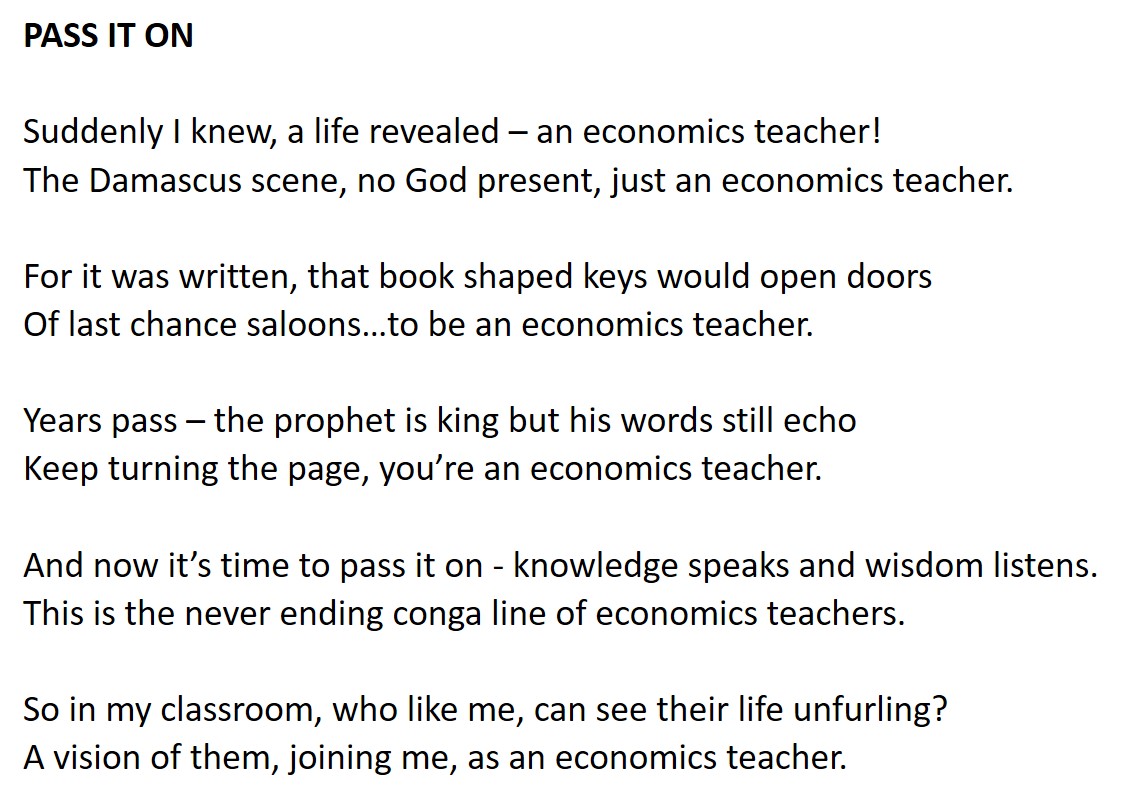
The poem that I have written relates to this and is in the form of a Ghazal. I have never written a Ghazal poem before but I was inspired by listening to Michael Rosen’s ‘Word of Mouth‘ show featuring renowned poet Raymond Antrobus. In the show, he reads one of his own poems called ‘Jamaican British’ which is a Ghazal poem and it’s really good. I thought I’d have a go and soon discovered that they are incredibly difficult to write and to be honest, I’m not really happy with what I’ve produced. I’m also not sure whether I’ve kept strictly to the rules of a Ghazal poem. I have done a minimum of 5 couplets and have obviously kept the rhyme and refrain but that’s about it. If you’d like to learn more about this then click here and you can read what the Poetry Foundation has to say about the Ghazal. It also has a link to some examples and I think the one from Patricia Smith is brilliant.

The poem and the quote from ‘The History Boys’ at the top is clearly about passing on your love for a subject (as my two Economics teachers did) and hope that as a teacher, your students might also feel the same way. I’m absolutely delighted whenever I hear about an old student of mine becoming an Economics teacher. I’m not vain enough to put that down to me but I hope I have inspired them in some way.

On a slightly different note, relatively recently I read a book by William Poundstone called ‘Are You Smart Enough To Work At Google‘ and it’s a really fun book to read. It’s basically an investigation into interviews around the world and the kind of questions you get asked. However, it also suggests that interviews are a bit of a waste of time because you can’t ever really tell whether someone is suitable for a position or not. Therefore, what is the best question you can ask at an interview that might help you make a good decision? He suggests that there is quite a good correlation between those who were passionate about the job/subject from an early age and their performance in it. For example, if someone has been constructing model airplanes during their formative years and eventually they want to be an airplane designer, the chances are they will be a success. Intuitively this makes sense. If you are passionate about something, then you will work really hard at trying to be the best that you can, even though you might not be good in the first instance.

In the world of teaching, I think this is hugely important and therefore I now include this in my interview questions for new recruits. If there is clearly an early driver of why they the wanted to become a teacher, I look upon this very favourably when making a decision. Otherwise you might end up with teachers that have come from an Armstrong and Miller sketch and that wouldn’t be good for anyone!

Summertime Blues – closing the attainment gap

One of the most interesting things about the use of evidence in education is the selective way that we use evidence in education. A few years back I attended a Wellcome Trust event that was looking to fund research projects that would explore ways of boosting educational attainment. For example, there were people there who wanted to run trials linked to mindfulness. I remember one person talking about the need to remove stripped fluorescent lights in classroom. One of the takeaways from the event though was the appreciation from most attendees that one of the real ways that we could improve student attainment was to start school later and yet we all knew that collectively that was very unlikely to happen, even though some areas have started to do this.

Obviously structural changes in education are very difficult to achieve and this can be seen with an issue like starting the school day later. Our society is based around a 9-5 culture and therefore it is inconvenient for adults if we change school times that would best suite teenage brains. However, given that schools are set up to improve the lives of children, then maybe it is something worth considering and this gets me onto the issue of the long summer holiday.

Just over a decade ago, Malcolm Gladwell wrote the book ‘Outliers – The Story of Success’ and it is probably best remembered for the (now) controversial claim that at least 10,000 hours was needed in order to become a ‘genius’ in your chosen field. Over time this number has been argued about and it has created some fascinating discussions about the genetic influence on success, the importance of deliberate practice and the role of luck. However, for me, this isn’t the chapter that stuck with me, although I have been engaged in many discussions about the 10,000 hours rule.

In Chapter 9 he discusses research that showed that the long summer holiday is bad for the poorest students in society. He quotes data from John Hopkins University that showed that across all socio-economic groups, test performances improve from one year to the next but those in the High Class out-perform those in the Low Class and over fiver years, the cumulative impact is quite vast. However, when the data gets broken down, the Low Class improvement is better during the academic year and much of the original gap occurs during the long summer holiday. He points out (which is a relief to all teachers) that school works!!! Karl Alexander (the head researcher at John Hopkins University at the time) calls this the ‘summer slide’ and you can hear him speaking about it here.

Clearly it’s an uncomfortable truth for teachers but if we genuinely care about those students from the poorest backgrounds, we should cut down our long summer holiday and get back into the classroom.

In my Economics GCSE class, I show a documentary called ‘Poor Kids‘ and it is a real eye opener for the many middle-class students I teach. Imagine, I ask them, what it must be like to spend 6 weeks without any money. For the majority of my students, they will continue to learn and gain ‘cultural capital’ over the summer as they’ll be taken to faraway places or they’ll visit museums and cinemas and the such like. Recently my daughter went to Thorpe Park and including her entry fee, transport and the price of food, the day was easily in excess of £60. If you think that Child Benefit is £20.70 a week and Job Seekers Allowance is a maximum of £73.10 a week, you can see how taking a child to one of these places (if your main source of income is benefits) can wipe out your weekly budget in no time. It’s easy to turn around and say that there are free activities for poorer children to do in the summer holidays but if you read a book like ‘Poverty Safari‘ by Darren McGarvey, you’ll soon discover how austerity has closed down community centres and there has been a huge decline in the number of libraries across the UK. We should also remember the phrase ‘the devil makes work for idle hands’ and you can appreciate how easy it is for poorer students to get into trouble out of sheer boredom, that could ultimately have long-term repercussions.

On the day it was announced that the attainment gap at GCSE is getting wider for disadvantaged students, it is worth reflecting what we can do from a structural point of view (based on evidence) that could help these students. No teacher wants to hear that their summer holiday should be shortened but ultimately, if we care about all students, then it must be done.

“Efficiency, efficiency, efficiency.”

In the Secret Barrister’s book ‘Stories of the Law and How it is Broken’, he discusses how the justice system is becoming more focused on getting cases through court in the name of efficiency, rather that the quality of the judgement. This is no surprise given the free market model that has been imposed on every bit of society, where targets are the norm and those in charge like an easy headline figure to discuss. If the Secretary of State for Justice can point to x amount of cases being completed in a day, then clearly the public are getting good value for money.

This ‘efficiency creep’ is something that I find myself thinking about on a regular basis within education. On Twitter, there are often discussions about the efficiency of a lesson and how we must think about the most efficient way of delivering a curriculum. This invariably leads onto a discussion about the efficiency of ‘direct instruction’ vs ‘discovery learning’ but also it can be about the wasting of time showing a video or having a ‘fun’ end-of-term lesson.

I saw one tweet recently from a teacher who told her Y9 students that their last lesson wasn’t the one at the end of term but at the end of Y11 and therefore they would carry on as normal. As someone who enjoys doing an end of term quiz, I found that quite fascinating. There was a certain level of martyrdom about the fact that they were teaching ’til the end and I assume this is all done in the name of efficiency. When it comes to a child’s education, there is no time to waste!

I don’t necessarily disagree with that viewpoint but I am wary of any discussion about efficiency within a classroom/school environment. I would argue in the name of efficiency we have seen schools start teaching GCSEs in Y9 because Y9 ends up being a ‘treading water’ type year. This means that students are choosing options in Y8 which seems rather early to make quite big decisions. And if you think starting in Y9 is the right thing to do because it focuses their mind, then why not start GCSEs in Y8? Some would argue that they start in Y9 because they need more time to teach the specifications but if that’s the case, start even earlier. If you don’t want to waste a single moment of time, let’s get the students onto GCSEs as soon as they enter secondary school!

This might end up narrowing the curriculum but so what? If you’ve got a headline figure like Progress 8 to aim for, then as a school leader you will want to be as efficient with your time as possible to score highly on this accountability measure.

Within a lesson, to be efficient, you have to keep on delivering and delivering and delivering. No time to think about your well-being or the student’s well-being. There is content to get through and this must be done as efficiently as possible. This will then also leave plenty of time to work on exam technique in the most efficient manner possible. Testing, testing and testing!

As noted right at the start, if (like the law courts) we get so focused on efficiency, we may end up reducing the quality of the educational experience. School is more than just efficiently churning out students that can pass exams. Schools are about relationships and appreciating the world around us. Schools are about giving students time to figure out who they are and where they might want to go in the future. Schools are places where you can make mistakes and there are people their to catch you as you fall. Schools are places to have fun and enjoy the experience of learning a wide variety of things.

And that’s why at the end of term, I like to do a two team quiz. A classic noughts and crosses board with a variety of categories in each square. Yes, they’ll be the odd question on my subject (Economics or Business) but they’ll also be a sports square (boys always choose this and then get annoyed when I ask them about anything other than football), a general knowledge square, a Mr Simpson Hums The Hit Parade square, a WORDS square (where they have to form a key Economics or Business word using their collective bodies), a Junior Jokes square (guess the punchlines) and so on.

In this quiz, students have to show leadership, have to listen to each other, have to make decisions about what answer to go for, have to show teamwork and they do all of this with smiles on their faces. It is their reward for working so hard throughout the term. Plus I also get to see a different side of a lot of students. These end of term quizzes help build relationships, which (dare I say it) will lead to a more efficient learning environment in the future!

The Joy of Podcasts – using podcasts to enrich learning!

With the rise in the listening of podcasts, educators may wish to consider curating their own content to enrich their students and help fellow teachers. This is what we have been doing with regards the teaching of Economics and we would recommend it for others as well.

Every teacher is faced with a specification for their subject that is often packed with content and it is therefore difficult to go into much depth given the time constraints on the teaching timetable. For example, in Economics, students are expected to know about the views of Adam Smith, Karl Marx and Friedrich Hayek. These are very complex ideas and therefore in class, you will only skim the surface of what they wrote and believe. Therefore in order to go into more depth, we decided to set up a podcast called ‘Economics in Ten’ that would give students the opportunity to learn beyond the specification.

The process of putting together a podcast might seem daunting for educators but once you get started, it is relatively easy to do. All you need is one good microphone, some basic recording equipment and a quiet room to record in. Once you have recorded, you must then find a podcast hosting site and again this is relatively easy as there are many podcast hosting sites out there. The one we use for ‘Economics in Ten’ is Anchor. Once you have uploaded it onto the hosting site, they will then place your podcast on the platforms that you would normally listen to podcasts on such as ITunes and Spotify.

With so much time pressure on staff and students to get through the content of courses, the rise of podcasts have given teachers the opportunity to offer additional content to their students. Not only that, the podcasts can be shared with the wider teaching community and this has certainly been the case with the ‘Economics in Ten’ podcast, where it is being listened to in schools across the world.

It is clear therefore that there are many advantages for educators but it also opens up other ways that you can interact and engage with students and fellow teachers about your subject. Through the ‘Economics in Ten’ handle, we have also set up an Instagram and Twitter account – @EconomicsinTen. This has given us more opportunities to share knowledge about our subject and engage in debate with students, which enriches learning. Many educators might not be very comfortable on social media but if you want to enthuse and motivate students, then you should use all the avenues open to you.

Introducing…

Hello everyone…I have entered the world of blogging in order to record my thoughts on the wonderful world of teaching, as well as education more widely.

I’ve taught for 20 years now and thought it would be a good time to share my wisdom. Having said that though, I am with Socrates when he said ‘The only true wisdom is knowing that you know nothing’, so this blog will share my thoughts and I will be happy to have these challenged. For a start…is that quote actually by Socrates? Or is it one of those phrases that gets attributed to every intellectual who has died under the sun?

Jimi Hendrix once said ‘Knowledge speaks, wisdom listens’, so I’ll try that type of wisdom as well. Although clearly no one spoke to him about the dangers of sleeping pills.

My blog posts will be there to start conversations rather than to end them and I hope you will find them thought provoking enough to share them with others who might also enjoy reading them.

Thanks for getting this far…have a lovely day and see you soon!

Design a site like this with WordPress.com
Get started